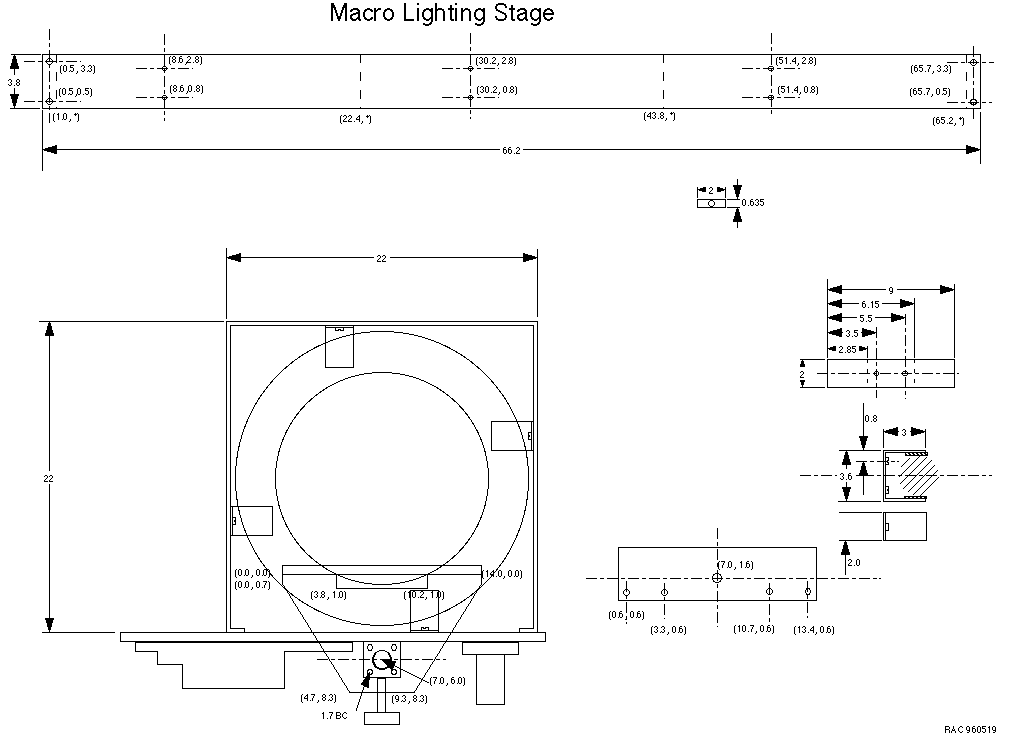
You can get a drawing showing the dimensions of the major components.
For greater rigidity use a couple of pieces of angle bracket screwed at least 11cm apart to a table leg. In the upper one drill (& preferably ream) a 1/2inch hole. In the lower one fix a piece of 1/2inch rod with a 1/2 degree taper machined at the upper end to take the diameter down to 0.393 inches. After removing any burrs present at the ends of the tube it may be dropped down through the hole in the upper bracket and push fitted on the taper. Works a treat.
The second method is to use some combination of the '3rd hand' accessories from RS. This makes it easy to adjust the position of the item in any axis. You can still use the grey card if required.
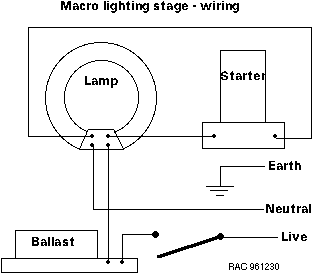
A circular fluorescent lamp gives a very even flood. Its disadvantage is a noticeable yellow/green cast. This is easy to remove using Photoshop but I intend finding a correcting lens filter some day (suggestions anyone?). You need to add a balast choke and starter (wiring diagram here). I couldn't find a connector for the pins but they solder easily. Put sleeving over the joints.
The basis of the design is a sliding collar made from 1inch square Duralumin bar about 35mm long with a 1/2inch hole drilled down the middle. This can be locked to the main rail with an M5 screw with some form of hand wheel on the end (I found the foot off a large piece of old equipment). One face of this block has four holes tapped in it to fix it to a beam made from 1/4inch thick Duralumin 32cm by 1.5inches.
Held on the same side of the beam as the collar are the ballast choke and the starter. On the opposite side is a U-shaped frame bent up from 3mm aluminium sheet. The lamp is held in this by four smaller U-shaped clips which have neoprene rubber linings to protect the glass. I made the frame the same width as the beam to which it is fixed but 2inches would be better.
Finaly, make up a perspex cover for the light stage. This performs three functions: it protects the user from contact with the electrics, it protects the lamp from damage from the camera and you can glue a sheet of aluminium foil on the underside to reflect light (that would otherwise go upwards) back down onto the object. Spray mount glue is ideal for sticking the foil. I bent the edge of the cover down over the ballast choke by heating strongly with a hot air gun.
The camera sits on a 1/4inch thick base plate with a cover of thin rubber to prevent sliding or damage to its base (cardboard would do). The standard camera fixing thread is 1/4" UNF. I found a 1/2inch long bolt in my 'scrap box' and made a 2.5inch diameter wheel to turn it by filing a slot in the centre and eight spokes around a 1/4inch dural plate - a joy to use after years of bruising my fingers tightening the fiddly little ones that you get on tripods.
The base plate and the collar are linked by a platform made from (guess what) 1/4inch dural plate. The exact width will depend on what camera you use and (in my case) whether it has a motor wind attachment. The end of the platform is best milled square where it abuts the base plate.
Was it worth the effort? Well it undoubtedly does the biz. The light is not as strong as you could wish; on occasions exposure time will go over a second at f22 but for most jobs it will be adequate. Whether you will want to replicate this rig depends upon how important the saving of several hundred quid is compared to how much you dislike the metal bashing involved.
| Item | Supplier | Stock code |
|---|---|---|
| Mounting rail | RS | 546-360 |
| Rod mounting clamps | RS | 546-366 |
| Extension rod | RS | 547-026 |
| Bar mounting kit | RS | 546-398 |
| PCB Clamps | RS | 546-427 |
| Jaw fingers | RS | 546-405 |
| 22W fluorescent lamp | RS | 570-464 |
| Balast choke (240V 50Hz) | RS | 562-047 |
| Starter | RS | 809-223 |
| Starter holder | RS | 562-019 |
| Neoprene strip | RS | 556-525 |
| Insulation sleeving | RS | 399-912 |
| Cable clips | RS | 819-387 |
| Power switch | RS | 119-0592 |
| Grey card | Techno | 035562 |
| Extension Tubes | Firstcall | - |
| Spray glue | Firstcall | 26250
|
 Richard's Home page]