
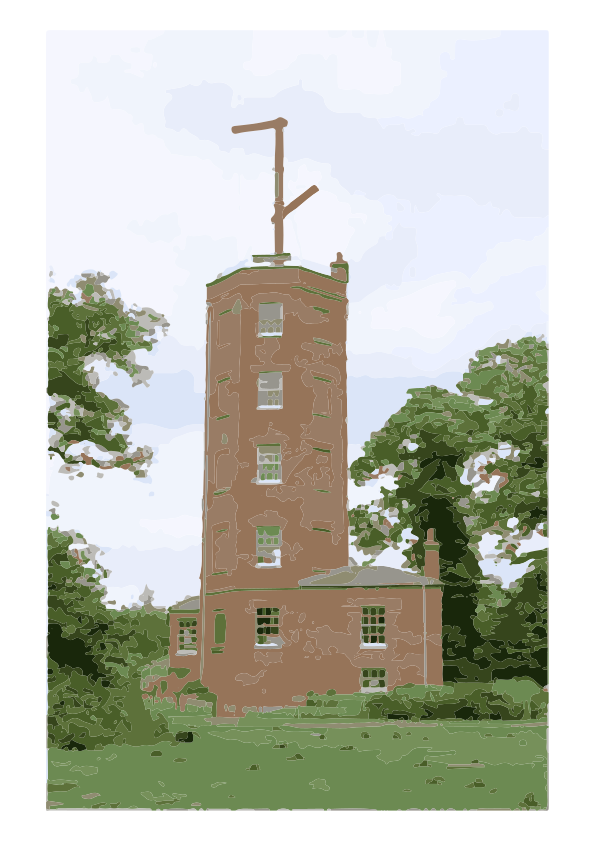
About the Semaphore Chain
In 1795 the navy decided to construct an optical telegraph system[tgr] using a chain of signaling stations to enable the Admiralty in Whitehall to communicate with the naval base at Portsmouth on the south coast. During the Napoleonic Wars, both British and French exploited optical telegraphs to transmit military commands. At first a shutter technique devised by Sir George Murray was used but the link was upgraded in 1822 by Home Riggs Popham[hrp] who chose semaphore instead.
Messages could be sent over the 108km path in about 15 minutes. The information superhighway of its age was in operation until about 1847 when the electric telegraph superseded it. The only surviving station now open (on occasion) to the public is at Chatley Heath in Surrey.
There were 15 nodes:
- Admiralty
- Chelsea
- Putney Heath
- Coombe Warren
- Esher
- Chatley Heath
- Guildford
- Witley
- Haslemere
- Woolbeding
- Marden
- Compton
- Portsdown Hill
- Eastney
- Portsmouth High St.
Dead tree:
- Holzmann and Pehrson, "The Early History of Data Networks", IEEE press, 1995, ISBN 0-8186-6782-6
- Holmes, Thomas W.,"The Semaphore", Stockwell, 1983, ISBN 0 7223 1629-1
- Wilson, Geoffrey, "The Old Telegraphs", Phillimore & Co. Ltd., 1976, ISBN 0 900592 79 6