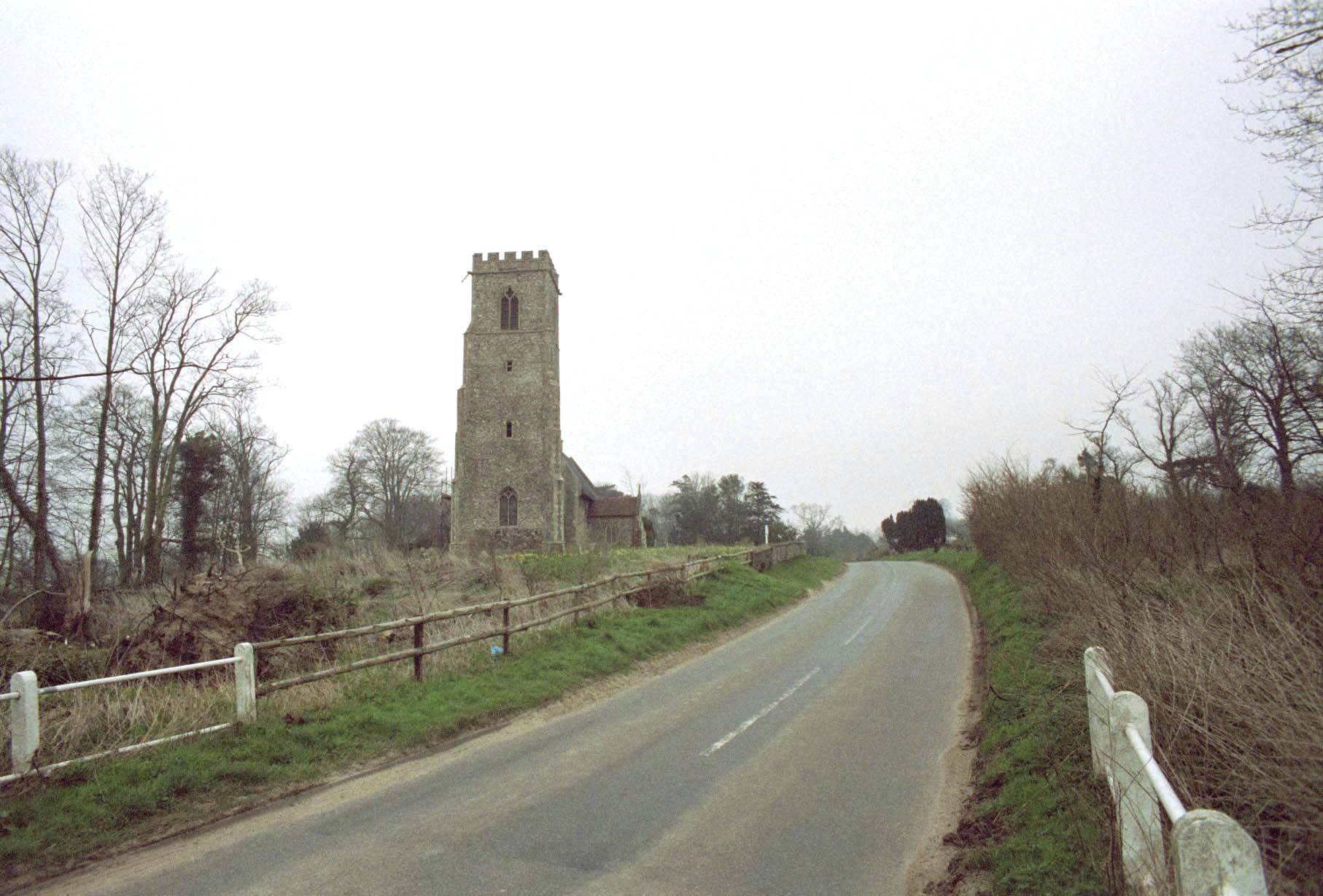
 A view of St. Mary's church, Henstead. This is from the Hulver
Street direction, as the Revd. Charles Clarke would have approached
it.
A view of St. Mary's church, Henstead. This is from the Hulver
Street direction, as the Revd. Charles Clarke would have approached
it.
A view of St. Mary's church, Henstead. This is from the Hulver
Street direction, as the Revd. Charles Clarke would have approached
it.
A view of St. Mary's church, Henstead. This is from the Hulver
Street direction, as the Revd. Charles Clarke would have approached
it.
The following notes on the history of the parish of Henstead in Suffolk were made in the 1930s by A.S.Clarke in order that the genealogy of his family (that he had compiled) could be put into a historical context. He draws upon secondary sources, in particular the 'History and Antiquities of Suffolk' by Alfred Inigo Suckling, to who ASC was related via his 1st cousin twice removed and wife of the Reverend Suckling: Lucy Clementina Clarke.
The vicissitudes of the Second World War caused ASC to leave his genealogy and these notes incomplete. Some of the words and names as given seem dubious, and should be verified independently before serious use is made of any. The punctuation is largely as per the original. Illegible, uncertain, missing or inferred text is shown thus.
Henstead was a beruite (a satellite village, RAC) only in Saxon times attached to the great manor of Wrentham; and was so considered at the compilation of the Conqueror's Survey. A carucate of land here was occupied by four villeins and nine bordars: one plough was employed on the demesne lands, and two were kept by the tenants. Its livestock was then enumerated at six cows, 40 sheep, 12 swine, and 20 goats, and its value estimated at 20 shillings. Two free-men, with 30 acres of land, had been added to Henstede when the Doomsday returns were made, and the two estates were held under William de Warren, by Godrey de Petro Ponte, or Pierpoint. (Doomsday 399b)
This family flourished for about three centuries in this neighborhood, but soon after this period their interests ceased in Henstead, and then Roger de St. Denis held Henstead by the service of half a Knight's fee. This was the manor afterwards called Blundeston, Savags1, and Henstead, which in the middle of the reign of Edward III was possessed by Alan de Henstede. Elizabeth, daughter of Sir Philip Branch Knt, by her will dated on 16th October 1438, bequeathed the manor of Henstead to her son Edmund Clere.
In 1442 and 1444 it was jointly held by William Paston, of Paston in Norfolk, and William Cove. They were succeeded by the family of Jenney. In 1490 William Yermouth was the patron, but in the 21st of Henry VII. Sir William Clopton, of Long Melford held the manor and patronage. Thomasine Clopton, his widow, had a life interest, and they continued in the same family until the 18th of Elizabeth, when the manor passed to William Sydnor of Blundeston, Esq., for the sum of £1720. There were certain other lands and rents in the surrounding parishes of Wrentham, Benacre, Salterly, South Cove, Fresenden, Northales, Reyden, Uggeshall, Stoven, Ruskmer, Kessingland and elswhere, included in this transaction. This manor, to which the patronage of the church of Henstead has been attached since the tenure of the Pierpoints, must have belonged to that family, though it is not apparent when it was first created,
The men of Pierpoints in this parish seems to have followed in the same descents as that of Wrentham, through the family Feines, Lord Dacres, to the Brewsters. This Lordship was styled the manor of Henstead, alias Perpounds, alias Poynings. By a deed, dated 29th of March 1585, Humphrey Brewster conveyed the manor to William Sydnor. From this period the two manors, though not united, have followed in the same descents.
In 1662, Sir Robert Brook, of Yoxford appears to have been the owner.
 Robert Sparrow of Worlingham Hall.
In 1687, Henry Mildmay, of Strawford, in the Parish of Twyford in Hampshire, was lord. He bequeathed to Anne Halliday, who was succeeded by her daughter Apphia Halliday, whose daughter Anne Halliday married John Amyas, of Beccles, Gent, and so the manor and advowson of Henstead descended to the Rev. John Amyas, clerk, their son, who was instituted to the rectory on 21st December 1793. Mr. Amyas sold the advowson of Henstead to Robert Sparrow Esq, of Warlingham Hall, in 1799 for £2500, and afterwards disposed of the manor to Thomas Kett Esq, of Seething in Norfolk. By this gentleman the manor was transferred to Charles Barclay, Esq, about September 1811. Mr Barclay sold to Robert Sheriffe Esq, about December 1834, from whom it passed by will to the Rev. Thomas Sheriffe about June 1842, who sold it to Sir Robert Inglis Palgrave of Belton. The Rev. Barker was next in possession, followed by his widow, and it is now (1936) in the possession of Mrs. Farmiloe.
In a deed dated the 16th and 17th of George II, the Lordship is described as the manor of Henstead perpound and Poynings, with the appurtenances, and of 10 messuages, 3 tofts, 16 gardens, 500 acres of land, 500 of meadow, 500 pasture, 30 wood, 600 furze and heath, 500 marsh, common of pasture for all manner of cattle, common turnbary, free fishery, court-leets, courts-baron, perquisites and profits of courts, rents, services, royalties, and jurisdictions. Although held by the same lords for nearly 3 centuries past, there are in fact, still two manors in Henstead. (1848)
A separate homage is sworn for each: and there are separate courts, though often held simultaneously. The earliest court-book in the possession of the present lord (the Rev. Thomas Sheriffe) begins December 21st, 1686.
Suckling's history of Suffolk volume 2 page 374.
1 Savags or Savage's, must be a term derived from some ancient possessor, and there is still a wood in Henstead called Savage's. (Suckling)
The village of Henstead is situated within the Hundred of Blything, in the northeast corner of Suffolk. The name has undergone various changes in spelling during the centuries, the following being some of the variations, Hanstede, Hantede, Hennyngsted, Henestede, Henetead, Hensted, Henstede, Hestede, Henstedes, Heanstead, Einsted, Enistate.
In 1734 the valuation of the Parish of Henstead St. Mary in the King's Books was £12.0.0.
In 1796 when the wastelands of Henstead with Hulver Street were enclosed under the Act of Parliament, the following was the state of the private property, waste lands, allotments etc. as taken from a book in the possession of the Rev. Wm Bailee of Wrentham, 1815 [Perh. Barlee - RAC].
| ALLOTMENT | ||||||
|---|---|---|---|---|---|---|
| A | R | P | A | R | P | |
| Rev. J. Amyas | 545 | 2 | 32 | 44 | . | 37 |
| Miles Barnes | 139 | 2 | 19 | 20 | . | 23 |
| John Clarke | 284 | 3 | 29 | 30 | 2 | 6 |
| Robt. Sparrow | 162 | 1 | 29 | 20 | 1 | 28 |
| Sir T. Gooch, Bart | 118 | 1 | 34 | 6 | 2 | 9 |
| and others to a total of | 1664 | 0 | 5 | . | . | . |
In 1641 the village of Henstead sustained considerable injury from fire, but the assertion contained in the following indenture, that the
church and chauncell of the said towne
were burnt, is disproved by the fact that the ancient nave of Norman construction is still remaining (1848). The old carved benches and woodwork of the interior most probably perished as did the greater part of the chancel. The fire was communicated from a farmhouse and premises adjoining the east end of the church in which it had broken out by accident. These premises, which were not rebuilt, stood opposite to the present Henstead Hall. In the parish register is the following notice of this event:–
Elizabeth, the daughter of Alexander Burnet, clerk, and Elizabeth his wife, was born in the parsonage-house of Henstead, 23 August 1641 and baptized the 10th day of September in the parish church of Rushmore, because the parish church of Henstead was then burnt down.
The following is a copy of the indenture mentioned above.
Two indres made after the fire at Henstead, April 12, 1658,
to remain in the hands of the said Thomas Clarke.
Between Thomas
Clarke, of Henstead, in the County of Suff., gent., of the one part, and
Thomas Love the elder, gent., Edward Ellis, gent., John Ellis, son of
the said Edward, John Clarke, gent., the only son of the said Thomas
Clarke, Thomas Aldred, John Aldred the elder, John Aldred the younger,
son of the aforesaid John, Matthew Balls, Nicholas Maye, and Edward
Judie, of the other part; witnesseth, that whereas by a sudden and
lamentable fire that happened in the said towne of Henstead, in the year
of our Lord God 1641, there was not onelie several howses of several
psons burnt downe by the same, together with the towne howse,
but att the same tyme the Church and Chauncell of the said towne, in
which there was a chest, where amoungst other things were all the
wrightinges and evidences that did concern or any waies belonge or
aptaine to the towne howse and landes belonging to the saide
towne of Henstead aforesaid, were alsoe burnte, consumed, and utterlie
lost, so that the inhabitants of the said towne now hath not any deedes
or wrightinges to shewe concerningue any pte of the same, but
onlye the coppie of an order or decree, which was, in the Year of our
Lord God 1608 risen downe in the five and thirtieth daye of the register
booke of the said towne, as by the said register book may appeare. And
further, whereas the sd towne landes have alwaies bin in the
handes of feoffes and of the survivour or
survivours of them, to such intents and uses as hereafter shall be
exprest. And whereas the said Thomas Clarke, being the only surviving
feoffe of the said towne lands of Henstead, being desirous that the said
town landes might remaine still in feoffes hands, and be imployed to
such uses, intents, and purposes as formalie the same have usually bin.
And that in tyme to come, those to whom it doth and maie Concern, may
not onlie take notice of what formly have happened, as before
is exprese, but also may knowe how, to whom, and in what
manner the towne lands aforesaid might be settled and conveyed, and to
what uses, intents, and purposes, that therebie the towne might enjoy
its rights, and for the bfits of all the landes aforesaid
might be imployed to right uses, accordinge to right, equitie, and good
conscience. Now this indre further witnesseth, that the
aforesaid said Thomas Clarke, for the considerations aforesaid, hath
enfeoffed, granted etc., to the aforesaid Thomas Love etc. to have and
to hold etc., or the survivors of them, that shall be present, shall,
upon the Monday in everie Easter weeke forever hereafter, within the
parish church of Henstead aforesaid, give full power and authoritie
under their hands unto the churchwardens of the said towne that are
chosen uppon the same daie and in the same place, to enter in and uppon
the above mensoned premises, and the same to demise and leate for a
year, yeares, or otherwise, as the said feoffes, or the greater
pte of them, then and there psent, shall agree
uppon, to the best value. And the issues and bfits thereof,
from tyme to tyme for evermore, by the churchwardens for the tyme being,
to jploye and bestow in and about the
repacons (reparations or repairs, RAC) of the church of the
said towne of Henstead, as need shall require; to the releife of the
poore there; and two other good, godlie, and charitable uses within the
said towne. Churchwardens to account at the year's end. And further,
that soe often as it shall happen in tyme to come, that the aforesaid
feoffes to die but three, that then these three so surviveinge, or the
survivors or survivor of them, when any of the inhabitants of the said
towne of Henstead, shall require it, shall make a new feoffment, and
shall nominate and enfeoffe other tenn men of the said towne of
Henstead, that shall be then seized of an estate of inheritance, or that
in probabilitie may hereafter be soe seized. And if there shall not be
soe many of the said towne there inhabitinge soe seized, that then they
shall nominate out of other townes
adioininge that have such an estate of inheritance.
An account of money and plate subscribed for Parliament 11th of November 1642 for Henstead.
| Edward Uttinge, clerk. | £2.0.0 |
| Thomas Clarke, in money | 1.0.0 |
| Diverse other persons | 1.5.0 |
| In plate, 1 oz x3 weight at 5d per oz | 0.7.9 |
With reference to this subscription see further note page 39
The valuation of the yearly revenue given unto the Commissioners at the Blythburgh, 11th of July 1649, according to the Act of Parliament, dated 4th April last for the maintenance of the Forces for the service of England and Ireland, Henstead £564.
In the year 1803, when the nation was threatened with invasion by the French, the government issued
Proposals for rendering the Body of the People instrumental to the General Defense in case of invasion,
under which certain returns from the several parishes in Suffolk were made respecting the amount of dead and livestock therein. The following return was made out at the beginning of the month of August.
| Cows | 58 | Young Cattle and Colts | 75 | Waggon Horses | 12 |
| Sheep | 37 | Riding Horses | 7 | Cart Horses | 14 |
| Pigs | 264 | Draft Horses | 45 | - | - |
| Qrts of Wheat | 54 |
| Qrts of Oats | 0 |
| Qrts of Barley | 0 |
| Qrts of Beans and Peas | 0 |
| Loads of Hay | 184 |
| Loads of straw | 26 |
| 1801 | 227 | 1861 | 534 |
| 1811 | 233 | 1871 | 552 |
| 1821 | 268 | 1881 | 537 |
| 1831 | 269 | 1891 | 488 |
| 1841 | 280 | 1901 | 455 |
| 1851 | 279 |
1821 Males 150 Females 118
The small stream marked on the ordnance maps as the Hundred River, but I believe known locally as "Willingham Water", runs close by The Grange. It arises in the parish of St. Lawrence Ilketshall, and, after running in a south-easterly direction, falls into the ocean at Benacre sluice, forming the boundary line between the hundreds of Blything and Mutford. It was probably a much more considerable stream in ancient days, as Hollingshed notices it in his Rivers of England. He says
Willingham Water cometh by Hempstead, Einsted or Enistate and falleth into the sea by south of Kesland.
[↑ top of page]
See also ...
[ Old charters, court rolls etc.]
[↑ About Alexander South Clarke]
Feedback to: richard at clarcana. info
Last modified: 2011 September 4th.