Publication history
"God save the King!" It is a large economy In God to save
the like;
but if He will Be saving, all the better;
for not one am I Of those who think damnation better still.
The trial of Robert Thomas Crossfield took place at the Old Bailey [1] on the 11th and 12th May 1796. The proceedings were recorded in short-hand by stenographer Joseph Gurney (the father of John Gurney, counsel for the defence) and were eventually published as the first trial to feature in volume 26 of Cobbett's Complete Collection of State Trials (CCCST26). Within a few years William Cobbett, under pressure to clear his debts, had sold his interest in the Collection to Thomas Curson Hansard.
Some early printings of CCCST's text of Crossfield's trial originally occupied 327 pages. Later, more condensed, versions used two-column pages. However, the 'page numbering' followed the columns, remaining more in step with the early version. In about 2012 a scan of CCCST26 was made available as a Google eBook. Google's transcription used OCR, but followed by light manual correction. Consequently, the text degenerated in places into large bloaks af oho3¼t ihkc/ogl hlib%yh$ 110l·
My transcription below, although presented as (hopefully) proofread, has only 79 of the original 'columns' converted. That is partly due to lack of time but also because the remaining parts are mostly from the indictment, jury selection, Justice Eyre's meticulous summing up, jurisprudential details given by counsel for the prosecution or defence, or parts of cross-examination unrelated to the family history which motivated this effort. Indeed, the charges are so belaboured you can imagine the defendants begging to climb the scaffold in preference to hearing more of them.
I have, though, added hyperlinks to as many of the names as could be googled. This turns out to be an impressive number. Thank you, Wikipedia.
Transcript
A
COMPLETE COLLECTION
OF
State Trials
AND
PROCEEDINGS FOR HIGH TREASON AND OTHER CRIMES AND MISDEMEANORS
FROM THE
EARLIEST PERIOD TO THE YEAR 1783.
WITH NOTES AND OTHER ILLUSTRATIONS:
COMPILED BY
T. B. HOWELL, ESQ. F.R.S. F.S.A.
AND
CONTINUED
FROM THE YEAR 1783 TO THE PRESENT TIME:
BY
THOMAS JONES HOWELL, Esq.
VOL. XXVI.
[BEING VOL. V. OF THE CONTINUATION]
36-58 GEORGE III ....... A.D. 1796-1798.
LONDON:
Printed by T. C. Hansard, Peterborough-Court, Fleet-Street
FOR LONGMAN, HURST, REES, ORME, AND BROWN; J. M. RICHARDSON; BLACK, KINGSBURY, PARBURY, AND ALLEN; BALDWIN, CRADOCK AND JOY; E. JEFFERY; J. HATCHARD; R. H. EVANS; J. BOOKER; J. BOOTH; BUDD AND CALKIN; AND T. C. HANSARD.
1819.
Digitized by Google
STATE TRIALS,
&c. &c.
CCCST Col. 1
611. Proceedings on the Trial of ROBERT THOMAS CROSSFIELD for High
Treason; at the Sessions House in the Old Bailey, on Wednesday the 11th
and Thursday the 12th Day of May: 36 GEORGE III. A. D. 1796.*
On the 31st of August, 1795, Robert Thomas Crossfield was apprehended at
Fowey
in Cornwall, sent up to London, and was committed by the privy
council to the Tower.
On the 14th of January, 1796, the Grand Jury for the city of London,
sitting at the Sessions-house in the Old Bailey, returned a true bill
against Robert Thomas Crossfield, Paul Thomas Le Maitre, John Smith and
George Higgins, for high treason.
On the 15th of January, Paul Thomas Le Maitre, John Smith, arnd George
Higgins surrendered themselves in court, and were committed to
Newgate.
On the 20th of January, Mr. Gurney was assigned by the
Court, of counsel for Paul Thomas Le Maitre, John Smith, and George
Higgins.
On the 16th of February, Mr. White, solicitor to the Treasury,
delivered to each of the prisoners a copy of the indictment, a list of
the jurors impanneled by the sheriffs, and a list of the witnesses to
be produced by the crown, for proving the said indictment.
On the 17th of February, Mr. Adam was assigned by the
Court, of counsel for Paul Thomas Le Maitre, John Smith, and George
Higgins.
On the 2Oth of February, Mr. Adam, and Mr. Gurney were assigned of
counsel for Robert Thomas Crossfield.
On the 5th of April, Robert Thomas Crossfield was removed by Habeas
Corpus from the Tower to Newgate.
At the session, on the 6th of April, the prisoners were arraigned on the
following indictment, and severally pleaded Not Guilty.
* Taken in short-hand by Joseph Gurney.
VOL. XXVI.
CCCST Col. 2
CAPTION.- London.
AT the general session of oyer and terminer of our lord the king holden for the city of London at Justice Hall in the Old Bailey within the parish of Saint Sepulchre in the ward of Farringdon without in London aforesaid on Wednesday the thirteenth day of January in the thirty-sixth year of the reign of our sovereign lord George the third king of Great Britain &c. before William Curtis esquire mayor of the city of London sir Archibald Macdonald knight chief baron of our said lord the king of his court of exchequer John Heath esquire one of the justices of our said lord the king of his court of Common Pleas Sir Alexander Thompson knight one of the barons of our said lord the king of his said Court of Exchequer Richard Clarke[2] esquire William Pickett esquire Paul Le Mesurier esquire Stephen Langston esquire aldermen of the said city John Silvester esquire and others their fellow justices of our said lord the king assigned by letters patent of our said lord the king made under the great seal of our said lord the king of Great Britain. To the same justices above named and others or any two or more of them directed to inquire more fully the truth by the oath of good and lawful men of the city of London and by other ways means and methods by which they shall or may better know as well within liberties as without by whom the truth of the matter may be better known of all treasons misprisions of treason insurrections rebellions counterfeiting clippings washings false coinings and other falsities of the money of Great Britain and other kingdoms or dominions whatsoever and of all murthers
CCCST Col. 3
felonies manslaughters killings burglaries rapes of women unlawful
meetings conventicles unlawful uttering of words assemblies misprisions
confederacies false allegations trespasses riots routs retentions
escapes contempts falsities negligences concealments maintenances
oppressions champartys deceipts and
all other evil doings offences and injuries whatsoever and also the
accessaries of them within the city aforesaid (as well within liberties
as without) by whomsoever and in what manner soever done committed or
perpetrated and by whom or to whom when how and after what manner and of
all other articles and circumstances coneerning the premises and every
of them or any of them in any manner whatsoever and the said treasons
and other the premises to hear and determine according to the laws and
customs of England by the oath of Henry Rutt William Arthur Adam Dennis
William Hunter Thomas Knott Joshua Knowles Alexander Lean Thomas Ayres
John Tombs Charles Aldridge John Guy Thomas Fellows James Slatford John
Back Charles Scholfield Joseph Aldridge and William Kine good and lawful
men of the said city now here sworn and charged to inquire for our said
lord the king for the body of the said city It is presented in manner
and form following (that is to say)
INDICTMENT. — London to wit.
The jurors for our lord the king upon their oath present that Robert
Thomas Crossfield late of London gentleman Paul Thomas Le Maitre late of
the parish of Saint Ann Soho in the county of Middlesex watch case maker
John Smith late of Westminster in the county of Middlesex aforesaid
bookseller and George Higgins late of London druggist being subjects of
our said lord the king not having the fear of God in their hearts nor
weighing the duty of their ailegiance but being moved and seduced by the
instigation of the devil as false traitors against our said lord the
king their supreme true lawful and undoubted lord and wholly withdrawing
the cordial love and true and due obedience which every true and
faithful subject of our said lord the king should and of right ought to
bear towards our said lord the king on the first day of September in the
thirty—fourth year of the reign of our sovereign lord George the
third by the grace of God king of Great Britain France and Ireland
Defender of the Faith &c. and on divers other days and times as well
before as after at London aforesaid (to wit) in the parish of Saint
Dunstan In the West in the ward of Farringdon without maliciously and
traitorously with force and arms &c. did
CCCST Col. 4
compass imagine and intend to bring and put our said lord the king to
death.
And to fulfil perfect and bring to effect their most evil and wicked
treason and treasonable compassing and imagination aforesaid they the
said Robert Thomas Crossfield Paul Thomas Le Maitre John Smith
and George Higgins as such false traitors as aforesaid on the said first
day of September in the thirty-fourth year aforesaid and on divers
other days and times as well before as after at London aforesaid in the
parish of Saint Dunstan aforesaid and ward aforesaid did together with
divers other false traitors whose names are to the said jurors unknown
with force and arms maliciously and traitorously conspire combine
consult consent and agree to procure make and provide and. caused to be
procured made and provided a certain instrument for the purpose of
discharging an arrow and also a certain arrow to be charged and loaded
with poison with intent to discharge and cause to be discharged the said
arrow so charged and loaded with poison from and out of and by means
of the said instrument at and against the person of our said lord the.
king, and thereby and therewith to kill and put to death our said lord
the king.
And farther to fulfil perfect and bring to effect their most evil and
wicked treason and treasonable compassing and imagination aforesaid
they the said Robert Thomas Crossfield Paul Thomas Le Maitre John Smith
and George Hiigins as such false traitors as aforesaid on the said first
day of September in the thirty fourth year aforesaid at London aforesaid
in the parish of Saint Dunstan aforesaid in the ward aforesaid with
force and arms maliciously and traitorously did employ and engage and
cause to be employed and engaged one John Hill to make and fashion divers
(to wit) two pieces of wood to be used as models for the making
and forming certain parts of the said instrument from and out of and by
means of which the said arrow was so intended to be discharged at and
against the person of our said lord the king as aforesaid for the
traitorous purpose aforesaid and did then and there deliver and cause to
be delivered to the said John Hill a certain paper with certain drawings
thereon drawn and designed as instructions and directions for making
such models.
And further to fulfil perfect and bring to effect their most evil and
wicked treason and treasonable compassing and imagination aforesaid they
the said Roltert Thomas Crossfield Paul Thomas Le Maitre John Smith and
George Higgins as such false traitors as aforesaid on the said first day
of September in the thirty — fourth year aforesaid and on divers
other
CCCST Col. 5
days and times as before as after with force and
arms at London aforesaid in the parish of Saint Dunstan aforesaid and
ward aforesaid did meet consult and deliberate among themselres and
together with divers other false traitors whose names are to the said
jurors unknown of and concerning their said intended traitorous killing
and putting to death of our said lord the king by the means and
instmment aforesaid and how and where such killing and putting
to death might be most readily and effectually accomplished.
And further to fulfil perfect and bring to effect their most evil and
wicked treason and treasonable compassing and imagination aforesaid they
the said Robert Thomas Crossfield Paul Thomas Le Maitre John Smith and
George Higgins as such false traitors as aforesaid on the said first day
of September in the thirty fourth year aforesaid at London aforesaid in
the parish of Saint Dunstan aforesaid and ward aforesaid with force and
arms maliciously and traitorously did employ and engage and
cause to be employed and engage one Thomas Upton to assist in making the
said instrument from and out of and by means of which the said arrow
was so intended to bc discharged at and against the person of our said
lord the king as aforesaid for the traitorous purpose aforesaid and did
then and there for that purpose deliver and cause to be
delivered to the said Thomas Upton a cerlain paper with certain figures
and drawings thereon drawn and designed as instructions and directions
for making such instrument and also certain pieces to wit two
pieces of wood as models for the making and forming certain parts of
the said instrument.
And further to fulfil perfect and bring to effect their most evil and
wicked treason and treasonable compassing and imagination aforesaid they
the said Robert Thomas Crossfield Paul Thomas Le Maitre John Smith and
George Higgins as such false traitors as aforesaid on the said first day
of September in the thirtyfourth year aforesaid at London aforesaid in
the parish of Saint Dunstan aforesaid and ward aforesaid with force and
arms maliciously and traitorously did deliver and cause to be delivered
to the said Thomas Upton a certain metal tube to be used by him the said
Thomas Upton in the making and forming of the said instrument from and
out of and by means of which the said arrow was so intended to be
discharched at and against the person of our said lord the king as
aforesaid for the traitorous purpose aforesaid and as part of such
instrument
And farther to fulfil perfect and bring to effect their most evil and
wicked treason
CCCST Col. 6
and treasonable compassing and imagination aforesaid they the said
Robert Thomas Crossfield Paul Thomas Le Maitre John Smith and George
Higgins as such false traitors as aforesaid on the said first day
of September in the thirty-fourth year aforesaid and no divers other days
and times as well before as after at London aforesaid in the parish of
Saint Dunstan aforesaid and ward aforesaid did together with divers
others false traitors whose names are to the said jurors unknown with
force and arms maliciously and traiturously conspire combine consult
consent and agree to procure make and provide and cause to be procured
made and provided a certain other instrument with intent thereby and
therewith and by means thereof to kill and put to death our said lord
the king
And further to fulfil perfect and bring to effect their most evil and
wicked treason and treasonable compassing and imagination aforesaid they
the said Robert Thomas Crossfield Paul Thomas Le Maitre John Smith and
George Higgins as such false traitors as aforesaid on the said first day
of September in the thirtv-fourth year aforesaid at London
aforesaid in the parish of Saint Dunstan aforesaid in the ward aforesaid
with force and arms maliciously and traitorously did employ and engage
and cause to be employed and engaged one John Hill to make and
fashion divers to wit two pieces of wood to be used as models for the
making and forming certain parts of the said last mentioned instrument
for the traitorous purpose last aforesaid and did then and there deliver
and came to be delivered to the said John Hill a certain other paper
with certain drawings thereon drawn and designed as instructions and
directions for making such models
And further to fulfil perfect and bring to effect their most evil and
wicked treason and treasonable compassing and imagination aforesaid
they the said Robert Thomas Crossfield Paul Thomas Le Maitre John Smith
and Georgc Higgins as such false traitors as aforesaid on the said
first day of September in the thirty-fourth year aforesaid
and on divers other days and times as well before as after with force
and arms at London aforesaid in the parish of Saint Dunstan aforesaid
and ward aforesaid did meet consult and deliberate among themselves and
together with divers other false traitors whose names are to the said
jurors unknown of and concerning their said intended traitorous
killing and putting to death of our said lord the king by the means and
instrument last aforesaid and how and where such killing and putting to
death might be most readily and effectually accomplished
CCCST Col. 7
And further to fulfil perfect and bring to effect their most evil and
wicked treason and treasonable compassing and imagination aforesaid
they the said Robert Thomas Crossfied Paul Thomas Le Maitre John Smith
and George Higgins as such false traitors as aforesaid on the said first
day of September in the thirty-fourth year aforesaid at London aforesaid
in the parish of Saint Dunstan aforesaid and ward aforesaid with force
and arms maliciously and traitorously did employ and engage and cauae
to be employed and engaged one Thomas Upton to assist in making the
said last mentioned instrument for the traitorous purpose last
aforesaid and did then and there for that purpose deliver
and cause to be delivered to the said Thomas Upton a certain other paper
with certain figures and drawings thereon drawn and designed as
instructions and directions for making such last mentioned instrument
and also certain pieces to wit two pieces of wood as models for the
making and forming certain parts of the said lat mentioned
instrument
And further to fulfil perfect and bring to effect their most evil and
wicked treason and treasonable compassing and imagination aforesaid
they the said Robert Thomas Crossfield Paul Thomas Le Maitre John Smith
and George Higgins as such false traitors as aforesaid on the said first
day of September in the thirty-fourth year aforesaid at London
aforesaid in the parish of Saint Dunstan aforesaid and ward aforesaid
with force and arms maliciously and traitorously did deliver and cause
to be delivered to the said Thomas Upton a certain metal tube to be used
by him the said Thomas Upton in the making and forming of the said last
mentioned instrument for the traitorous purpose last aforesaid and as a
part of such last mentioned instrument against the duty of the
allegiance of them the the said Robert Thomas Crossfield Paul Thomas Le
Maitre John Smith and George Higgins against the peace of our said lord
the king his crown and dignity and against the form of the statute in
that case made and provided.
[It appearing to the Court that the proper officer had not summoned the jury in time for the prisoners to take their trial at the present session, the trial was postponed to the next session.]
Sessions House in the Old Bailey. — Wednesday, May the 11th, 1796.
PRESENT, Lord Chief Justice Eyre; Mr.
Justice Grose; Mr. Recorder; and others his Majesty's Justices,
&c.
Counsel for the Crown. — Mr. Attorney General [Sir John
Scott, afterwards Lord Chancellor
CCCST Col. 8
Eldon]; Mr. Solicitor General [Sir
John Mitford, afterwards Lord Redesdale and Lord Chancellor of Ireland];
Mr. Law [afterwards Lord
Ellenborough, and Lord Chief Justice of the Court of King's Bench];
Mr. Garrow [afterwards a Baron
of the Court of Exchequer]; Mr. Wood [afterwards a
Baron of the Court of Exchequer]; Mr.
Fielding; — Mr. Abbott
[afterwards, successively, a Judge of the Court of Common Pleas, and now
(1818) Lord Chief Justice of the Court of King's Bench.]
Solicitor. — Joseph White, esq. Solicitor to the Board of
Treasury.
Counsel assigned for the Prisoner. — Mr Adam [afterwards
Lord Chief Commissioner of the Jury Court, and a Baron of the Court of
Exchequer of Scotland]; Mr. Gurney.
Assistant Counsel for the prisoner. — Mr. Moore; Mr. Mackintosh
[afterwards Recorder of Bombay.]
Solicitors for the prisoner
Mssrs. Foulkes and Cooke, Hart street, Bloomsbury square.
The Attorney General said, that he understood the prisoners meant to
separate their challenges, he proposed to proceed to the trial of
Crossfield.
Robert Thomas Crossfield set to the bar.
[Mr. Shelton, the Clerk of the Arraigns, called over the
Panel]
Hilton Wray, esq. challenged by the prisoner.
John Anderson, merchant, not a freeholder in the city of London to the
value of 10l. a year.
John Vincent Gandolfi, merchant, challenged by the prisoner.
Thomas Dunnage, merchant, excused on account of age.
Peter Pope, esq. excused on account of age.
Abraham Favene, merchant, excused on account of illness.
John Naylor, merchant, challenged by the prisoner.
Joseph Norville, merchant, not a freeholder. David Jones. merchant,
challenged by the crown.
Thomas Latham, merchant, not properly described in the panel.
John Mair, merchant, not a freeholder.
Sir Walter Rawlinson
, banker, excused on account of illness.
Jobn Henry Schneider, merchant, challenged by the prisoner.
Claude Scott, corn—factor, challenged by the prisoner.
Rowland Stephenson, banker, excused on account of deafness.
James Atkinson, merchant, challenged by the prisoner.
Richard Heatley, merchant, not a freeholder.
Duncan Hunter, merchant, challenged by the crown.
William Axe, stock-broker, not properly described in the panel.
CCCST Col. 11
Thomas Ovey, hatter, challenged by the crown.
John Mackenzie, oilman, challenged by the prisoner.
Thomas Jeffries, linen draper, one of the people called Quakers.
William Parker, glassman, excused on account of illness.
Thomas Abbott Green, silversmith, not a freeholder.
Walter West, ironmonger, challenged by the prisoner.
Benjamin White, bookseller, sworn.
Stephen Adams, silversmith, excused on account of illness.
Andrew Abbott, potter, not a freeholder.
John Reid, distiller, sworn.
Phillip Rundle, goldsmith, challenged by the crown.
William Collier, gent. challenged by the prisoner,
John Coe, taylor, sworn.
| John Greenside, | William Norris, |
| Fran. Barstow Nixon, | William Gosling, |
| William Walker, | Daniel Pinder, |
| Alexander Black, | Benjamin White, |
| William Shone, | John Reid, |
| Arthur Windus, | John Coe. |
The Clerk of the Arraigns charged the Jury with the Prisoner in the
usual form.
The Indictment was opened by Mr. Abbott:
Mr. Attorney General. — May it please your lordship,
gentlemen of the Jury; In the discharge of the very painful duty, which
belongs to the situation which I hold, I am called upon this day to
address you with reference to a case of a most serious nature, whether
it is considered with regard to the public, or the prisoner who stands
at the bar: — Gentlemen, the indictment which you have heard read
charges the prisoner with the highest offence known to the law of our
country, and it charges the prisoner with the most aggravated species of
that highest offence. — It charges him with compassing and
imagining the death of the king, and with hav!ng, for the purpose of
carrying that imagmation into execution, prepared the means of
destroying the person of the sovereign.
Gentlemen, I shall have very little occasion, in the course of what I
have to offer to your attention, to say much to you upon the law of this
particular case; I shall state it to you in the words of a great judge,
a man attached unquestionably to the genuine principles of this
constitution, whose name has long been revered and will continue to be
revered whilst the constitution of the country itself shall endure
— I mean the late Mr. Justice Foster — He states the statute
of the 25th Edward 3rd upon which this indictment is framed, and which
you probably will hear read and commented
CCCST Col. 12
upon by great modern living authorities: he states the statute in these
words "When a man doth compass or imagine the death of our lord the
king, and thereof be upon sufficient proof attainted of open deed by
people of his own condition." He states that in the case of the king,
this statute of 25th Edward 3rd, has with great propriety retained the
rule that the will is to be taken for the deed. With respect to homicide
in the case of individuals, the law of this country once was, that even
as to them the will should be taken for the deed: that law hath been
altered in the case of private individuals; but it remains unchanged
with re-spect to the sovereign of the country, and the reason why the
law hath been continued, as it anciently was, with respect to the king,
is stated in the book which I have been reading to you, as follows: "The
principle upon which this is founded is too obvious to need much
enlargement: the king is considered as the head of the body politic, and
the members of that body are considered as united and kept together by a
political union with him, and with each other; his life cannot in the
ondinary course of things be taken away by treasonable practices without
involving a whole nation in blood and confusion: consequently every
stroke levelled at his person, in the ordinary course of things,
levelled at the pubtic tranquillity. The law; therefore, tendereth the
safety of the king with an anxious concern, and, if I may use the
expression, with a concern bordering upon jealousy. It considereth the
wicked imaginations of the heart to be of the same degree of guilt as if
carried into actual execution from the moment" — (And I would beg
your attention, gentlemen, to this passage:) "From the moment that
measures appear to have been taken to render them effectual."
Gentlemen, God alone can read the heart of man: and, the legislature has
therefore, insisted upon this, in every trial between the king and a
prisoner indicted, that he shall be attainted of open deed by people of
his condition: that is to say, that some measures shall be taken to
effectuate that evil imagination of the heart, some fact shall be done
or attempted to be done, in order to prove to man's judgment that that
conception and that imagination did enter into the man's heart. —
This measure, proof of which is made necessary by the law, is ordinarily
known by the name of an overt-act, and every indictment for treason, as
you will bear, must charge that the party compassed and imagined the
death of the king, and then it must state, upon the face of it, those
circumstances and facts, which are the measures, by which the prosecutor
insists that the party has disclosed that traitorous compassing and
imagination of his heart.
Gentlemen, the present indictment specifies several such overt-acts.
With respect to many of them, conspiracy with others is of the
essence
CCCST Col. 17
Upon principle – whether that principle was founded in the law of the
country or not, it is not material for me at this moment to consider
— but from principle, they refused to permit the evidence in this
business to be laid before them in the order which had a natural
tendency to make that evidence intelligible; they took the whole matter
into their own hands, and, examining all the parties upon the subject,
and particularly examining that person of the name of Upton, who I have
before described to you as an accomplice, they found the bill against
all the prisoners.
Gentlemen, unwilling as any person would have been, undoubtedly, to have
tried this cause upon the credit of Upton alone, or of Upton confirmed
by any other individual, or confirmed even by strong circumstances, it
would unquestionably have been my duty if it had been in my power, to
have called that person here today, to have given his evidence to you,
but withal to have stated, as far as it became me, and under the
correction of the wisdom which presides here, that his evidence ought to
have been received with great jealousy and with great attention, that
you ought to protect, against such a witness, a prisoner, put upon
his deliverance before you, till your unwillingness to receive his
testimony had been subdued by conscientious conviction, arising out of
all the circumstances of the case, not only that he was as guilty as he
admitted himself to be, but other persons represented by him to be
equally guilty with himself actually were so.
Gentlemen, it has however happened whether fortunately for justice or
not I will not take upon myself to determine, because in my situation
and as a man I do feel that, if on the part of the public I have to
regret that this man's testimony cannot be offered to you, on the other
hand, that I ought to remember, that if this man's testimony could have
been refuted by any circumstances established on the part of the
prisoner, or if by any examination addressed to him by the prisoner, or
by others, the innocence of the prisoner could be established, it would
be undoubtedly a public duty to produce such a person; — he ought
to be produced, with a view that guilt might be detected if it does
exist, and, on the other hand, that innocence may be established if it
has been improperly accused. Since the bill however was found, it has
happened that by the act of God that man has ceased to exist: he is
dead; and I shall have occasion probably, in the course of what I have
to offer to your attention, to prove that circumstance. It is very
remarkable that – as I should unquestionably have asked you, if I had
had that person to have produced as a witness at the bar this day, not
to convict the prisoner upon his evidence, unless you had been satisfied
by his evidence as confirmed by other testimony in the cause of the
prisoner's guilt, I say it happens very remarkably, that I have a case
to lay before
CCCST Col. 18
you, in which I may say in the outset, as I should have been disposed,
if he had been here, to have said in the conclusion, that you may lay
his testimony out of the case from the beginning to the end of it.
Gentlemen, I — shall proceed now to state to you the circumstances
of this case, as they affect the prisoner at the bar, Mr. Crossfield. It
was in the month of August, I think, 1794, that the charge was first
brought forward by Upton; and being very unwilling (though it is both a
delicate and a difficult task to avoid it) to make any such direct
representation to you as he made to others upon the subject, I had
better, perhaps, proceed to state to you the effect of that
representation, by mentioning to you the facts which I am instructed to
say the witnesses whom I shall call will prove against the prisoner,
than detail to you what Upton personally represented with respect to
any one of these facts.
Gentlemen, there are two questions of fact. which will deserve your
particular attention. The first is, whether the prisoner at the bar
really was engaged in a concern to fabricate such an instrument as is
mentioned upon this record; and the next question for you to try will
be, whether, if that be demonstrable and clear, it is or is not equally
clear that that instrument, which he was so engaged in fabricating, was
fabricated with the intent and for the purpose charged in this
indictment — that is, to compass what he had imagined, the death
of the king. With respect to the former of these facts, you will find by
a witness whom I shall call to you, of the name of Dowding, that in
September, 1794, upon the 8th of that month (and I should here advise
you, that some of those witnesses whose testimony I am about to state do
not know the individuals, or some of the individuals, who applied to
them, but it will be distinctly proved to you by other persons that will
be called who those individuals were). a person of the name of Dowding,
who is a journeyman to a Mr. Penton, that lives in New-street square,
and who is a brass-founder, will inform you that, upon the 8th of that
month, in the afternoon, three men — whom I now state to you
were Upton, who is dead; the prisoner; Mr. Crossfield; and a person of
the name of Palmer, who will be called, came to his master's shop; that
they asked him for a tube three feet long, and of five-eighths of an
inch diameter in the bore: you will find he states the dimensions to be
the same as other brass founders to whom they apply — five
eighths of an inch in the bore, and it was to be smooth and correct in
the cylinder in the inside The witness will inform you, if I am rightly
instructed, that he showed them a piece of a tube, and asked if that
would do with respect to the size of it; that they informed him it would
do, but that it must be thicker, in order that it might be smaller in
the bore; the expense of it they seemed anxious about in their
inquiries; the expense
CCCST Col. 19
he stated to them in general would be high, but what would be the
particular expense of it be could not take upon himself to state: he
inquired what they wanted this tube for; and you will find, if I am
rightly instructed with respect to his evidence, that the answer given
to that was, that the purpose for which they wanted it was a secret, and
that they could not disclose it to him.
Gentlemen, they applied upon the same day to another person of the name
of Bland (the former not being able to supply them with the article that
they wanted), who is a brass-founder at No. 40, Shoe-lane, Fleetstreet:
there were but two of them that came originally to him, and you will be
satisfied that they were Upton and the prisoner, They asked for a tube,
for a pattern to make another by: after they had asked for this tube,
Palmer came in. This witness not being able to supply them, you will
find they made another application upon the same day to a person of the
name of James Hubbart, who lives in Cock-lane, Snow-hill, and is
likewise a brass-founder; he lives in the shop of a person of the name
of Michael Barnett, to whom he was apprentice: and upon their addressing
a question to him similar to that which they had addressed to the
witnesses whose names I have before-mentioned, he referred them to a
person of the name of Flint, who is a man in the same shop, and who will
likewise be called to you; and he will inform you that they asked him
also for a tube; the barrel, I believe, was to be five-eighths of an
inch in the bore, and about the eighth of an inch in thickness; that
they proposed to finish it themselves, if the witness would cast and
bore it: the witness told them that he must have a pattern; and then
some conversation passed with respect to this pattern. They were very
anxious to know, as you will find from his testimony, how long it would
be before this barrel could be made: he gave them an answer upon that
subject: and you will hear under what circumstances they parted with
him. After these applications had been made to these several brass
founders, Upton and Crossfield, the prisoner at the bar, applied to man
of the name of Hill, who will likewise be called to you, Palmer being
also in their company; and the evidence that Hill will give you is this
— that Crossfield produced to him a paper, which I have now in my
hand, which contains the model of part of an air-gun; that is to say, it
contains a drawing, by which drawing Hill, whose business was that of a
turner in wood, was to fabricate the wooden part of the instrument, Hill
you will also find, asked them what they wanted this instrument for;
they did not inform him that it was a secret; but they told him that it
was for an electrical machine.
Gentlemen, this paper will deserve your very particular attention;
because I have reason to believe that you will find not only that
CCCST Col. 20
this paper was delivered by Mr. Crossfield to Hill, but that that part
of the writing upon the paper, which states the dimensions of the
instrument, is in the hand-writing of Mr. Crossfield. Hill, in
consequence of this, following the drawing, turned some of the wooden
parts of the model, a part of which I have now in my hand; and which.
It will be proved to you he carried, according to his orders, to Upton, in
whose possession it will be proved that this part of the wooden model
was found, as well as the tube, which I have now in my hand. It will be
material for you to give your particular attention to these
circumstances by-and-by.
Gentlemen, besides all this, it will likewise be proved to you, that
there was in the posession of Upton another drawing, containing models
of the instrument which we have charged in the first part of the
indictment was to eject an arrow for the purpose of destroying the king;
and when I have to state to you by-and-by the conversations of the
prisoner Crossfield which will be proved with respect to the tube and the
arrow, and the nature of the instrument, you will see the materiality of
the circumstances to which I am at present calling your attention. The
other paper I have in my hand; and It contains different parts of this
intended instrument. There is one part of it, to which you may think
your particular attention is due; because, if I prove the circumstances
that I have already stated, it will be incumbent upon the prisoner, I
apprehend, more particularly after the evidence which I have to offer to
you with respect to the intent, to give you some evidence for what
purpose such an instrument as this was actually constructed. Here is a
drawing of the arrow, which is of the form that you may see perhaps by
my holding the paper up to you in this manner: It is like a harpoon, and
it has this peculiar circumstance about it, that it is so formed, that
when it presses against any hard substance the two forks of it compress
together, enter into the substance, and there is a hole at the end of
it, which would then emit some substance, which it is calculated to
hold.
Gentlemen of the Jury, it will also be proved by another witneas whom I
shall have to call, of the name of Cuthbert, that Upton and the prisoner
went to him some time in the month of August, 1794, for the purpose of
looking at an air-gun that Cuthbert had. Cuthbert appears to have been
an acquaintance of Upton's. You will hear from the witness himself what
was the conduct of the prisoner at the bar with respect to that air-gun
!n the possession of Cuthbert: he examined it; he handled it; stated
that it would do very well for the purpose; and after a conversation of
this sort they left Cuthbert.
Gentlemen, it may probably be proved, if it be necessary with respect to
the case of this prisoner, that some of these instruments which I have
been stating were in the hands
CCCST Col. 21
of the other parties whose names are upon this record; it is also
possible that papers, material to establish the facts alleged against
some of these parties, may be thought, according to the course which
this cause may take, necessary to be produced in evidence upon this
trial; but, without detaining you with respect to the particulars of the
evidence which applies to other persons, I think, if I prove the facts
that have been already stated as against Mr. Crossfield, and if you
shall find that there is distinct evidence of the intention with which
he was engaged in drawing these models, and providing for the
fabrication of these instruments, that there can be very little doubt
indeed in respect of his case.
Gentlemen, when the other parties were apprehended, I have before told
you that Mr. Crossfield absconded. I believe I shall be able to prove to
your satisfaction by a witness whom I shall have to call to you of the
name of Palmer, whose name I have before mentioned, some of the
circumstances I am now about to open to your attention, as well as a
great many of the circumstances which I have already stated.
Mr. Crossfield usually lived in London. The first place in which he hid
himself, after this charge was made, was Bristol: he returned afterwards
from Bristol to London: and from London be went to Portsmouth, where he
engaged himself on board a ship called the Pomona, which was employed in
the South Sea Whale fishery. I probably need not mention to you
gentlemen that the voyage of a ship, engaged in that commerce, is of a
considerable duration — sixteen or eighteen months I believe
— being a surgeon, he hired himself at Portsmouth on board that
vessel. He went usually by the name of doctor: it will be proved to you
by witnesses who come forward in this business under circumstances, that
entitle them to great credit, at least so I submit to your
consideration, that this vessel sailed from Portsmouth to Falmouth; that
during the voyage from Portsmouth to Falmouth you will find, if I am
rightly instructed, with respect to the representations that the
mariners on board this vessel have made, Crossfield conducted himself
with the greatest decency and propriety; his name however was unknown.
They sailed from Falmouth, and after they got out to sea in the progress
of their voyage Mr. Crossfield informed the witnesses who will be called
to you who he was. You will hear the account that he gave of himself,
the account that he gave of the part, that he had in this transaction,
the circumstance of his relating his escape, and his declarations that,
if it was known that he was leaving this country in that vessel, the
government would probably send a frigate after him, that he states in
the most distinct manner even before the capture of the Pomona to some
of the witnesses that will be called to you, circumstances of his own
connexion and transaction in the business, which
CCCST Col. 22
I have been opening to you, with express and clear and pointed reference
to these models, to the tube, to the arrow, and to the other particulars
that I have opened.
Gentlemen, in the course of the voyage this vessel was taken by a French
Corvette, the
La Vengeance
[3]
: she was carried into Brest: you will hear from the
witnesses the conversation that passed between them and Mr.
Crossfield, when this capture took place: the satisfaction which
he expressed that he had got even out of that situation of
danger which he conceived himself to be in whilst he was a part
of the crew of any English ship: the satisfaction that he had,
in having been captured by a French frigate, and taken into that
country where he would be safe. You will hear what the whole of
his demeanor was whilst he remained on board that French ship
which captured him, and when he was in the harbour of Brest. He
was first removed, in consquence of conduct, the details of
which will be given by the witnesses as connected with this
business, from the French Corvette into another vessel called
the Elizabeth, which was an English ship, that had been captured
by the French, and out of her into another vessel, which was
called the Humphries, and there are persons in respectable
situations from among the prisoners, that were detained in each
at these vessels to state to you evidence which, without
detailing it to you particularly, I think can leave, if It is
entitled to any credit, no doubt upon your minds that, if Mr.
Crossfield was concerned in the fabrication of these
instruments, or the drawing of these models, the intent, with
which he was concerned in that fabrication and that drawing, was
most distinctly the purpose and the intent charged in this
indictment, i.e. the intent to kill the king.
Gentlemen of the jury, you will not be surprised if you hear
from witnesses, whose testimony will be given to you, that Mr.
Crossfield, being carried into Brest under such circumstances as
I have stated, was rather in the situation of a superintendant
over the English prisoners on behalf of the French, than as a
companion with those unfortunate persons who had been captured
by the French, and were detained in their prison ships there. I
have reason to think that you will also find that it was his
project either to remain there or to go into Holland. In a
course of time however
cartel
ships were to come over into this country; with what
intention Mr. Crossfield came over into this country it is not
for me to examine nor to insinuate. You will collect this
yourselves from the testimony which those witnesses will give
you but you will hear circumstances which are remarkable enough
— that Mr. Crossfield was constantly in company with the
commissary of the French prisoners — that he will appear,
according to the testimony of one of the witnesses, to have gone
ashore a day or two before these cartel ships left Brest, in
order to meet a member
CCCST Col. 23
or members of the Convention; that shortly before he left that country
he took the name of Wilson: that in his own hand-writing he was mustered
among the prisoners by the name of Wilson, as having been captured by
the La Vengeance, not out of this vessel called the Pomona, but out of a
vessel called the Hope; for what purpose he changed his name, or for
what purpose he changed the name of the vessel in which he was captured,
it will be for you to determine, when you have heard the whole of the
evidence.
The witnesses will also state to you the circumstances which took
place when the prisoners were put on board the cartel ships, and you
will see that it was familiar to the commissary of the French
prisoners, that this man should pass by the name of Wilson, as having
been captured in the Hope, and that under that false name he should come
over to this country. Gentlemen, you will also hear the witnesses inform
you that in the course of the voyage between Brest and this country,
Mr. Crossfield distinctly desired one of them, the only one I believe
who was in the vessel in which he came over, not to state his name, and
not to state those circumstances of conduct and the declarations which
had taken place whilst he and that witness were detained together in
the harbour of Brest. They landed I think at Fowey in Cornwall, in the
neighbourhood of Mevagissy. Some of these seamen,
the witnesses, who are persons in respectable situations on board ships,
mates and officers, thought it their duty, under a very different
impression with respect to Mr. Crossfield's conduct, than perhaps that
which they might have had if they had known what had been passing in
this country, but yet under an extremely serious impression in their
minds, to go instantly to a magistrate to inform him what had passed in
France, with respect to the conduct of this person. In conseqnence of
that charge made by persons who knew nothing of what had been passing in
this country, except so far as the circumstances that had been passing
in this country had been related by the prisoner himself, the prisoner
was apprehended; being apprehended, it will be in evidence before you
that, as he went before the magistrate from Fowey or Mevagissy to the
county gaol, that he intimated to the persons who were conducting him
there, that it might be for their interest to permit him to escape: he
stated to them that a sum of five shillings was all that they could
expect for the execution of the duty, which they were then upon: that he
had the means of giving them much more. These persons will state to you
the whole of the conversation which passed, and on the suggestion I
think of one of them that the plan would not answer the purpose of Mr.
Crossfield, because the driver would still be to be disposed of, and
asking the question what would become of the post boy the answer given
to that was that the post boy might be
CCCST Col. 24
disposed of by the use of a pistol which one of these officers had.
Mr. Crossfield was brought up before his majesty's privy council, and he
was committed to the Tower, and in consequence of all this additional
testimony, which has immediate relation to Mr. Crossfield, but which
connects itself with the circumstances which have before been stated
with respect to the other prisoners, it became a matter of duty to
submit the whole of the case to a grand jury of the country; They found
the bill, the prisoner's deliverance upon which is now before you.
I have studiously forborne to mention several circumstances which relate
more partlcularly, and more especially to other persons whose names are
upon this record. If I prove this case, as I am instructed to say I
shall prove it and if I prove it as I have opened it to you, I apprehend
there can be no doubt of this prisoner's guilt. If that be the result of
the testimony which is given to you, gentlemen, though it is a painful
duty, it is a duly absolutely incumbent upon me, to ask at your hands,
on the behalf of the country, the verdict of GUILTY. On the other hand,
if you are not satisfied that the offence of high treason according to
the statute, is proved by evidence according to law, against the
prisoner; certainly you do no more in that case, than your duty to your
country requires, in aquitting the prisoner.
You have before you a case of great importance. It is a case, which I am
sure you will listen to with great attention. I am confident that you
will decide it with unimpeachable integrity and in your verdict,
whatever it may be, I hope the country will feel a perfect satisfaction
that they have had the case deliberately considered, and honestly
decided upon, by the twelve men, to whom I have the honour to address
myself.
Lord Chief Justice Eyre. — Mr. Attorney General you do not
open any particular conversation upon the point of connexion of this
instrument with the use that you suppose was meant to be made of it; if
you in your judgement conceive that the conversation that did pass will
support that connexion I shall be so perfectly satisfied with that
declaration, that I think we may go on; if it were otherwise, an
observation would occur upon the case as you have opened it.
Mr. Attorney General. — I will state why I did not mention the
particulars of the conversation, I think it is better the witnesses
should state the conversation in their own way of stating it, than that
counsel should undertake to make a representation of it; I understand
myself to be pledged to the Court, to this, that the conversation was
the most direct that can possibly be stated for the purpose of proving
an intention as connected with the instrument.
Lord Chief Justice Eyre. — I am Perfectly satisfied
with that declaration.
Mr. Attorney General. — yet if the Court
CCCST Col. 57
will not supply the want of another witness; that may possibly be, but the use of the confessional evidence is at present to make the first part of the evidence intelligible, which it is not, nor do I know it ever will be; but it may, perhaps, appear from these declarations of the prisoner, whether the prosecutor's evidence can be rendered intelligible or not, out of the mouth of the prisoner – the authority cited shows, that the prisoners confession is to be received in explanation, and corroboration of the evidence offered, and it may be offered upon the ground of their being already two witnesses to the overt acts insisted upon; but I am of the opinion, that it might be offered if but one witness at present had appeared, because another witness, after they have made this evidence intelligible, may come and give other evidence of another branch of the overt act; there is no rule of floor which says, that you shall establish the overt act by the evidence of two witnesses first, before you shall hear any confessional evidence, and that is the only question in the cause.
John Le Bretton sworn. — Examined by Mr. Garrow.
You sailed from Falmouth, I understand, on board the Pomona? —
Yes.
What were you? — Boat-steerer.
What was the Pomona? — A South Sea whaler.
You sailed from Falmouth, on the 13th of February, 1795? — We
did.
Where were you bound to? — The Southern fishery, round Cape
Horn.
Do you know the prisoner, Crossfield? — I do.
How long before you sailed, had you seen him? — He came on board
our ship about a week before we sailed from Portsmouth.
Can you tell us at what time he did sail from Portsmouth? — On the
29th or 30th of January, I cannot say which.
In what character did he come on board? — As surgeon.
By what name did he pass, from the time he came on board at Portsmouth
till you sailed? — By the name of "the doctor," as is most
commonly used on board a ship.
Did you understand that to be a description of his profession as doctor?
— Yes.
Did you know his name at that time? — I did not.
Lord Chief Justice Eyre. — Do you receive men in this
situation without having their name taken down?
Witness. — The captain might have his name taken down, but
I did not know his name.
Mr. Garrow. — You sailed on the 13th? — Yes.
On the 15th you were taken by a French corvette called Vengeance?
— Yes.
And were carried into Brest? — Yes.
You arrived there on the 23rd? — We did, to the best of my
knowledge.
Until after you were captured by the French
CCCST Col. 58
corvette, had you ever heard, from the prisoner, what his name was, or
heard him called by any description but "the doctor?" — Not until
we arrived at Brest.
What name did he then assume? — He wrote his own name in the list
that was to be sent on shore, "Robert Thomas Crossfield."
Were you shifted before you went into Brest? — Part of us were
taken into the Frenchman.
Did the prisoner or you go in the first number that went out of the
English ship into the French ship? — The prisoner went in the
first number.
Do you recollect any expression of the prisoner, when he went over the
ship's side? — Yes; as he was going over the side, he wished me
and the chief-mate good by, saying, "he was happy he was going to
France, he would sooner go there than to England."
When you arrived at Brest, did you find the prisoner there? — Yes;
on board the same corvette that had taken us.
After you had gone with your ship into Brest, were you put on board the
same ship with him? — The Pomona was turned adrift, and we were
taken into the same corvette as they were in.
By what name did he pass in France? — His own name in the muster
list.
Were you mustered frequently? — Yes.
What was the conduct of the prisoner on board the Pomona, before he was
captured? —
Lord Chief Justice Eyre. — If you mean to apply it to this
particular subject, very well; but as to any other misconduct of any
other kind —
Mr. Garrow. — I mean to prove what was his conduct before he was
taken, and then to contrast it with his conduct on this particular
subject..
Lord Chief Justice Eyre. — But I think, there ought to be
nothing given in evidence against the prisoner, that may operate to his
disadvantage, until you have fixed something upon him to which that has
a relation; till then it is all prejudice.
Mr. Garrow. — Then I must transpose the evidence. After you had
arrived at Brest, did you hear the prisoner make use of any expressions,
with respect to his majesty the king of England; or as to any share he
had had in any matter which related to his majesty? — Yes,
I did.
Be so good as state very deliberately what they were? —
I heard him say, he was one of those who invented the air-gun, to
assignate his majesty — to shoot his majesty.
Did you put any question in consequence of his saying that? — Yes, I
asked him what it was like; he told me the arrow was to go through a
kind of tube by the force of inflammable air.
Did he describe the arrow? — Yes; he described it like one of our
harpoons, which we kill whales with.
The harpoon is a barbed instrument? — Yes.
CCCST Col. 59
Did he explain the properties of the barbs of the arrow, that was to be
used for this purpose? — I do not rightly recollect any farther than
that.
State any other expressions vou heard from him relative to the same
subject, or relative to the king of England, during his imprisonment
there? — I do not rightly recollect.
Did he use those expressions you have mentioned, once or more than once?
— I heard him talk of the gun several times.
This was a conversation with yourself? — Chiefly with myself.
Do you recollect any songs that he sung?
Mr. Adam. — Does your lordship think that is evidence.
Mr. Garrow. — I mean to state that they were seditious.
Lord Chief Justice Eyre. — I think you had better forbear
that examination.
Mr. Garrow. — You told us you found him at Brest, by the
name of Crossfield — How long did you continue in prison at Brest,
the prisoner passing by the name of Crossfield? — Till we came
away.
In what manner were you to be brought from Brest to this country?
— By a cartel which came from the
West Indies.
When the cartel was ready, and you were about to be
transferred into that, what name did the prisoner assume? — The
name of "H. Wilson."
Who made out the muster list for the purpose of transferring you from
the French ship into the other? — He was one himself.
Had he acted at all as muster master? — Not at all, any Englishman
used to write the names he stood at the gang-way, and put the people's
names down, and he put down his own name "H. Wilson," the first or
second name.
Did you hear the persons called over according to the list? — We
had not the muster list called over; I saw that wrote in it.
Did he embark in the cartel by the name of Wilson? — He did.
The ship out of which Crossfield was taken was the Pomona? — It
was.
Was he described in the list as H. Wilson of the Pomona or as of any
other ship? — As of "the Hope."
Mr. Adam. — Your lordship observes the witness is now
giving parol testimony of a writing.
Lord Chief Justice Eyre. — This paper I apprehend ought to
be in some public office?
Mr. Attorney-General. — It is left in France.
Mr. Adam. — Do you know what became of that muster
list?
Witness. — I do not; I believe it goes to the
representative of Brest.
Mr. Garrow. — Was any profession described? — It was
"H. Wilson, of the Hope, a passenger taken by the same vessel."
CCCST Col. 60
Did you hear any other disrespectful or seditious expressions from the
prisoner, respecting his majesty, that you recollect, while you were at
Brest? — I do not recollect others.
Lord Chief Justice Eyre. — The whole is, he absconded; and
when he was to return to England, he assumed a feigned name. I do not
think his not being a loyal subject is evidence against him upon this
case.
John Le Bretton cross-examined by Mr. Adam.
Do you know any thing of your own knowledge with respect to the manner
in which this muster list is disposed of? — I cannot tell.
For any thing you know, this muster list is sent over to to the
Admiralty of England? — It may be for what I know.
Are you sure you read this muster list with attention, at the time you
have been speaking to? — I am sure that I both saw and read it
over.
And you can charge your memory correctly at this distance of time with
what you have stated? — Yes.
What was your situation on board the Pomona? — Boat-steerer.
What was the number of the Pomona's crew? — Twenty-three, I think,
the captain included?
What was the captain's name? —
Charles Clarke.
Did he continue a prisoner in France with you all the time? — He
did.
Did he come back in the same cartel ship with you to England? — He
did.
Have you seen him frequently since he came back to England? — I
did a good while since.
How long since? — Never since last Christmas.
Were you examined before the privy council upon this business? — I
was.
Was captain
Clarke examined before the privy council? — I believe
he was not.
Did he attend at the time you attended? — Not at the privy council he
did not.
Have you seen him since your examination before the privy council?
— Yes.
Where? — In London.
In what particular place? — At the solicitor's. Mr. White's.
Have you ever seen him in any other place? — Yes.
Where? — On board his ship.
Have you never seen him at any house on the banks of the river
Thames? — I have at his lodgings in Wapping.
Where were his lodgings in Wapping? — By Gun-dock.
Who is the landlady of the lodgings at Wapping? — I do not
rightly recollect the name.
Should you recollect the name if it were mentioned to you? — I
should.
CCCST Col. 61
It is not a very uncommon name, you know? — I do not know for
that.
Was the name White? — No.
Thompson? — No.
Was it Williamson? — No.
Was it Smith — No, it was not.
His landlady's name then is not Smith? — Not at the last time he
came to London.
But since your return from captivity, have you seen him at Mrs. Smith's
at Wapping? — Yes; I was there once or twice with him, but he did
not lodge there.
Do you know Mrs. Smith of Wapping? — No farther than just by
calling there with him.
When was it you saw him two or three times at Mrs. Smith's? — At
the time he was fitting his ship out, after his return from France.
Had you any conversation with him at that time upon this subject?
— I cannot rightly say that I had.
Then if any body were to come and say that you had conversation with him
upon this subject at Mrs. Smith's at Wapping since your return from
France, they must of course not be speaking truth? — No; I do not
know that they could?
Then for any thing that you recollect, you may had had conversation with
him at Mrs. Smith's at Wapping? — I might have talked to him.
I am not asking you about general conversation; but whether you talked
about Mr. Crossfield the prisoner? — I do not recollect.
Your recollection is very accurate to the words Mr. Crossfield spoke,
and to words you read in a paper, and both those things happened a great
whHe before this meeting at Mrs. Smith's at Wapping. I ask you, upon
your oath, do you not recollect any conversation you had with captain
Clarke at Mrs. Smith's at Wapping, since you came back from France, upon
the subject of Mr. Crossfield and upon this accusation? — I do
not.
Will you positively take upon yourself to swear you never had any?
— No farther than I told him I had been examined before the privy
council.
Then now you recollect that you had been examined before the privy
council, and that you told him so? — Yes.
In consequence of your telling him that you had been examined at the
privy council, did nothing farther pass relative to Mr. Crossfield
— No, it did not.
Did you not ask him whether he had not overheard Mr. Crossfield say such
and such words upon the subject? — No, I did not.
I put it to you again, and recollect that you are upon your oath. You
say you do not recollect having had any conversation with captain
Clarke
about what captain
Clarke must have overhead pass between you and Mr.
Crossfield, upon the subject of this accucation? — No, I did not.
Neither at Mrs. Smith's nor any where
CCCST Col. 62
else, since your return from France, nor since your examination at the
privy council? — I did not; nor captain
Clarke never was so
inquisitive as to ask me.
Nor were you so communicative as to tell him? — No.
How often might you see captain
Clarke at Mrs. Smith's? — I do
not know that I called there with him above two or three times.
Is he your captain now? — Yes.
Where is he now? — He may be on the coast of Africa for aught I
know.
How long is it since he left England? — At Christmas last.
When did you return from France? — I believe we landed the 1st or
2nd of September, I cannot say for a day or two.
I think you told us Mr. Crossfield came on board the ship at Portsmouth?
— I did.
And that you sailed upon the 13th from Falmouth? — Yes; and were
taken upon the 15th.
What day did you sail from Portsmouth? — On the 29th or 30th, I
cannot say which.
How long had Crossfield been at Portsmouth before you sailed? — He
came on board us about a week before we sailed.
And you knew him by the name of "the doctor;" for aught you know your
captain might have known his real name? — He might.
During the time that the ship lay at Portsmouth, before she sailed from
St. Helens, were you frequently in company with Mr. Crossield? —
At meal times.
Did you ever come on shore with him? — He was on shore two
different evenings with me, at Portsmouth.
Who came on shore besides him and you? — The boat's crew.
How many might that boat's crew consist of? — Five men.
Did you come on shore together? — Yes.
Did you go to places of public resort? — No.
Mr. Crossfield went publicly about the streets with you? — Yes.
This was in the month of January? — Yes.
You were driven into Falmouth? — We went into Falmouth.
What was the ship loaded with? — Casks of water, and provisions
for the voyage.
Do you mean to say upon your oath, that casks of water and provisions
for the voyage, were all that the captain and the ship's crew had laid
in, for the purpose of trafficking to the South Seas? — No.
What was there besides? — The captain's private trade.
What did that consist of? — I cannot say.
Had not you private trade of your own? — Nothing but two dozen pair of
stockings.
Did not the private trade of the captain and the crew consist
of jewellery, trinkets, watches, and other articles? — He had
something of that kind.
And to a considerable value? — Yes, I believe he had.
CCCST Col. 63
You put into Falmouth by stress of weather? — By the wind getting
on to the westward, and we were afraid to stay at sea, on account of the
French.
What day did you put into Falmouth? — I believe it was the end of
February, I cannot say rightly for the day, having lost my journal.
You sailed the 13th, and remained ten or eleven days at Falmouth?
— Yes.
Did you remain some time in the harbour? — We went to the
Roads.
Were you frequently on shore? — Yes.
Was Mr. Crossfield frequently on shore at Falmouth? — He was never
on shore more than once, if he was that.
That you are positive to? — Yes.
Were you on shore with him at that time? — I cannot say that I was.
You cannot tell how long he remained on shore? — I do not know that he
was on shore at all; if he was on shore, it was not more than once.
If you do not know that he was on shore, you cannot take upon yourself
to say any thing about it.? — No, I cannot tell whether he was on
shore or not, because I do not know any thing about it.
You sailed upon the 13th, and were captured upon the 15th? —
Yes.
As soon as you were captured, were you all put on board the
corvette? — No.
How long was it before your being put on board the French ship, after
your capture, and being carried into Brest? — From the 15th to the
28rd.
During that time, what sort of weather had you? — Pretty moderate
for the time of year.
How many English prisoners were there of you altogether on board that
ship? — There were none but our ship's crew at first.
Do you recollect any scheme upon the part of your ship's crew to take
possession of the French ship? — Yes, I do.
Who was concerned in that scheme? — We were all concerned in it,
as far as I know.
Captain
Clarke was concerned? — He was.
You were concerned? — Yes.
Mr. Crossfield was concerned? — I believe he was.
And that was between the period of your capture and the period of your
getting into Brest? — It was about three days after our
capture.
How did that scheme fail? — By one or two being disheartened, and
the prisoners we took from other ships being outlandish men, and not
agreeing to it.
Will you swear that Mr. Crossfield was not one of the foremost in that
attempt; was he not ready to enter sword-in-hand into the cabin, to make
that rescue? — I was not in cabin, and I cannot pretend to say what I
did not see.
Where were you first taken to, when you went into Brest harbour? —
Into the Roads.
Did you go along-side any other English ship? — No.
CCCST Col. 64
Had you any intercourse with the English prisoners of other ships at
that time? — Not until we got on board the prison-ship.
You were removed from the ship in which you were taken into a
prison-ship? — We were.
Did you meet any English prisoners in that other prison-ship? — Yes,
numbers.
Do you recollect the names of any of them? — No, not rightly.
Was not Mr. Crossfield carried on board the prison-ship with you?
— He was.
What was the name of that prison-ship? — The Elizabeth.
What ship lay along-side the Elizabeth, the nearest ship? — I
cannot rightly say what was the nearest ship to us.
Do you remember the L'Achille? — Yes.
Was not she close to you? — Pretty near hand.
Was not the Normandy close to you? — She was pretty near.
I need not ask you whether Mr. Crossfield speaks French? — He
does.
Did not he serve in common as an interpreter between the prisoners that
could speak French, and those who could not? — Some times he did;
there were several that could talk French.
Do you know any of the English sailors that were on board the L'Achille
or the Normandy? — Not the particular ones.
Do you remember any captains? — Not to know their names; I should
remember them if I saw their persons.
Do you remember captain Yellowley? — Not in particular; there was
a captain Yellowley, who was captain of the transport we came over in;
he was not on board the prison-ship.
Where did you meet him? — In Landernau river.
Do you remember Mr. Cleverton? — I do.
Where did you know him? — He was taken by the same ship, two or
three days after we were.
Did he come on board the same prison-ship with you? — He did.
Did He stay on board that prison-ship, the Elizabeth, during the whole
time Mr. Crossfield and you were on board her? — He did.
Mr. Crossfield, of course, was acquainted with him? — For aught I
know he was.
You did not mess with Mr. Crossfield, at this time, did you? — I
did not.
Do you know whether Mr. Cleverton messed with him? — I believe
he did.
Do you know captain Collins? — There was a captain Collins
there.
Was he on board the Elizabeth prison-ship? — I do not know; I
remember a person of that name being there.
You were afterwards removed from the Elizabeth prison-ship to another;
what ship were you removed to? — The ship I went on board of was
the Peggy.
What ship lay along-side, next the Peggy?
CCCST Col. 65
— The Active Increase; they were lashed along-side each other;
they lay so close that I jumped from one to the other.
And they were both used as prison-ships? — They were.
Did Mr. Crossfield go on board the Peggy with you? — He was on
board the Peggy.
Was Mr. Cleverton on board the Peggy? — He was.
Was captain Yellowley on board the Peggy? — I do not know that he
was.
Was captain Collins on board the Peggy? — I do not remember any
such name on board the Peggy.
Do you remember such a name on board the Active Increase? — I do
not.
Captain
Clarke was on board the Peggy? — He was.
Now, from the time you were removed from the Elizabeth prison-ship, in
Brest harbour, to the Peggy and Active Increase in Landernau river, till
you came back to England, Crossfield, yourself,
Clarke, and Cleverton,
were all on board the same ship? — Not all the time, they were
not.
But the greatest part of the time? — I cannot say how long.
At what time was any one removed? — Mr. Cleverton was sick, and
at the hospital, for some time.
I believe, when any prisoners appeared to be sick, or stated themselves
to be sick, they were immediately taken from on board the prison-ships
to the hospital on shore? — Yes.
So that if any of the prisoners on board these ships were taken with an
accidental sickness, they were removed to the hospital? — They
were carried to the hospital on shore when they were very bad.
Were they not carried on shore when there was any reason to suspect they
had any disease? — They let them be pretty bad first, and then
they were taken on shore.
After Mr. Cleverton recovered, he came back to the prison-ship? —
Yes.
And then he remained on board the Peggy till you all embarked on board
the cartel lor England? — Yes.
Who commanded the cartel? — Captain Gallowley, or Yellowley, I do
not know whether his name is with a Y or a G.
Was captain Collins on board the cartel? — I cannot tell whether
he was or not; there was a captain Collins, who commanded one of the
transports there.
Long belore the return of the cartel, you knew that the person who was
called "The Doctor," was Mr. Crossfield? — Yes.
And so did all the ship's crew? — I cannot pretend to say that; I
saw his name wrote, and I saw him.
I think you said that he continued a prisoner under the name of
Crossfield till you came away? — Till nearly we came away.
Of course he was known as a prisoner by the name of Crossfield? —
By the name of "The Doctor," in general.
CCCST Col. 66
But any body that chose to be satisfied about his real name, would know
his name was Crossfield? — Yes, there was no secret about it.
You said the captain's private trade and your private trade consisted of
some cotton stockings? — Yes.
Did they take up any considerable room in the ship? — I cannot say
they did.
They were easily stowed away? — There were three or four large
trunks.
They could have passed perfectly well for the clothes and wearing
apparel ol the persons to whom they belonged? — I do not know for
that, because a person could not wear a considerable number of stockings
and all that.
Upon your oath, were not those articles conveyed on board the prison
ships, and made the subject of sale, by the different persons who had
been taken prisoners? — There was a trifle which they had, which
they broke open.
There was a trifle taken and sold? — The ship's crew got them among
them.
Was there any quarrelling and any dispute about them? — I do not
remember any.
Do you remember Mr. Crossfield making any observation about it?
— I do not.
Had you never any words with Mr. Crossfield upon that subject? — I
never had any words with Mr. Crosslield to my knowledge.
You are perfectly sure that there never were any words between you and
Mr. Crossfield upon this subject? — I do not know that I ever had
a word in anger with him.
Did you ever hear him tell the people that had those stores, that he
would inform the underwriters that they never had been captured? —
I never did.
Thomas Dennis sworn. — Examined by Mr. Wood.
Were you chief mate of the Pomona? — Yes.
Did you sail in her from Portsmouth? — Yes, the latter end of
January.
Do you remember the day? — No; I believe between the 29th and
31st.
Did the prisoner sail in the ship with you? — he did.
In what capacity? — As surgeon.
What name was he called by? — I did not rightly know his name; he
went always by the name of "Doctor."
How soon did you know his name? — Not till we got into France.
Was the Pomona captured? — Yes, on the 16th of February, by the La
Vengeance, a corvette.
Where was she carried into? — Into Brest.
Had you ever seen the prisoner before he came on board at Portsmouth?
— Never.
In the course of your voyage, did you ever hear him say any thing about
what would be done if it was known where he was gone? — Yes; the
night after we sailed from Falmouth, he said "if Pitt knew where he
was, he would send a frigate after him;" moreover "that
CCCST Col. 67
Pitt would have been shot, only he crossed some bridge in the room of
Westminster bridge;" the bridge I have forgot.
Did you ever hear him say any thing about his majesty? — Yes; I
heard him say "his majesty was to be assassinated at the playhouse with
a dart blown through a tube, and that he knew how the dart was
constructed." Did he tell you how it was constructed? No, I heard
nothing farther about the dart.
Did he say any thing about the form of it?
No, I never heard him mention any thing about the form; I believe he
mentioned something about "its being in the shape of a harpoon;" but I
cannot tell particulars.
Did you on hear him say any thing more upon that subject? —
Nothing more about the king.
Did you understand from him what was to be done with this dart? —No
more than he said "his majesty was to be assassinated
by it."
Did he say any thing about the construction of the tube? — No
farther than "that the dart was to be blown through a tube."
After the capture, did you hear him say any thing about his being glad
to leave England? — When we were first taken, Crossfield took me
by the hand, and said "he wished I might get a ship safe to England; he
was glad he was going to France, and was happy he had got out
England."
On your arrival at Brest, was there any muster taken? — Yes, the
list of prisoners was made out, and sent on shore.
Did Crossfield sign his name? — Yes; "R. T. Crossfield;" and he
said "he had no occasion to be ashamed," or "to be afraid," I am not
sure which, "of his name now."
How long did he go by that name? — All the time he was in
France.
Did he change it to any other name? — Yes; the day the list of
prisoners was made out to be sent to England, he changed his name to
"H. Wilson."
Did you see the list in which the name of H. Wilson was entered? —
Yes, I over-hauled it; it mentioned " his being captured in the Hope
Brig," instead of the Pomona.
By what ship was it mentioned he was captured? — By the same
ship, the La Vengeance.
Was that in his own hand-writing? — Yes.
Did you hear the list called over? — I did.
Who called it over? — The commissary from Brest.
What name was he called by? — H. Wilson.
Did he answer to that name? — Yes, and he walked aft directly.
Were you the person who gave information to the magistrate of
Crossfield? — No; I heard of it upon the road, as I was coming
from Cornwall to town, at a place called St. Austle, or at Bodmin; at
Bodmin, I believe.
Whom did you inform of this? — I was subpœnaed before the
privy council.
But to whom did you give intelligence of what had passed? — To
nobody; I never mentioned it before.
CCCST Col. 68
You did not go before any magistrate? No; I never mentioned his name to any body till I was subpœnaed; I was going to sea the next day.
Thomas Dennis cross-examined by Mr. Gurney.
You sailed from Falmouth on the 13th, and were taken on the 15th —
How many days were you upon your voyage to Brest, after you were taken?
— I believe we got into Brest on the 22nd or 23rd.
Then you were seven or eight days upon your voyage? — Yes.
Do you recollect any plan being formed in the course of that voyage,
among the English prisoners, to seize the French ship? — I do.
Were you concerned in that plan? — Yes.
Was Captain
Clarke concerned in it? — Yes.
And Mr. Crossfield? — Yes, I believe he intended to be one.
In fact, you all meant to rise upon the French, and to seize the ship?
— Yes.
Were you of that party in which Mr. Crossfield was to be? — The
people were to be upon deck, and those in the cabin were to seize the
arms in the cabin.
You were put on board the Elizabeth in Brest harbour? — Yes.
Near which there were the L'Achille and the Normandy? — Yes.
The corvette took another vessel after she had taken you, before she got
back to Brest? Yes.
What was the name of that other vessel? — The Hope brig.
Who was captain of her? — Mr. Faulkner.
Was Mr. Cleverton on board that vessel? — He was.
Was he put on board the Elizabeth with you and Mr. Crossfield? —
He was.
How long did he remain on board the Elizabeth? — As long as we
staid.
Were captain Yellowley and captain Collins on board the Elizabeth?
— No.
They were captains of cartels? — Yes, in Laudernau river.
The Active Increase was close to the Peggy? — Along-side of
her.
Captain Yellowley and captain Collins were captains of two cartels near
you? — Yes.
You had access to these vessels? — Sometimes.
Mr. Crossfield, after some time, left the Peggy? — Yes.
On board what ship did he go? — One of the ships in which captain
Collins, captain Yellowley, or captain Alexander were — I cannot
tell which.
Who was captain of the Active Increase? — Captain Fearnley: he
died.
You were enabled, by the politeness of the French captain, to save some
part of the private trade of the captain and of yourselves? —
Yes.
What did that private property consist of? — Stockings, chiefly,
CCCST Col. 69
Some watches? — The captain saved some watches.
And jewellery, some trinkets? — Yes.
Was this property insured? — I do not rightly know.
Do not you know that? — I had none of my own insured.
Do you not know that captain
Clarke's was insured? — I have heard
it was.
These articles were afterwards the subject of traffic on board the
prison-ship, were they not? — Yes.
You recollect some observations being made by Mr. Crossfield, respecting
this being a fraud upon the underwriters? — Not to my
recollection.
Try and rub up your recollection a little? — It never concerned
me.
I ask you whether Mr. Crossfield did not not expressly charge you and
captain
Clarke with defrauding the underwriters, by the sale of these
articles? — Never me; he did not charge me.
Did you never hear him charge captain
Clarke? — No.
Had you never any words with him upon the subject? — No.
That you are sure of? — Yes.
Then if any body should swear that you had, they will swear what is
untrue? — Yes, if they swear I had any words with the doctor upon
that subject.
Or he any words with you? — Or he any words with me.
Was there no quarrel between you and Mr. Crossfield when on board that
ship? — No, I do not rightly know; I never exchanged fifty words
with him to my knowledge, all the time we were in France.
How many did you exchange with him before you went to France, fifty
more? — I cannot say.
Perhaps you were not in habits of great intimacy? — My station was
on deck; his station below.
Did any words pass between you, respecting any negligence of your's, by
which the ship was taken? — Never, to my face; I heard he had said
so behind my back. I was informed so, I never heard it from himself.
Did you never talk with him upon that subject? — No.
You are sure of that? — Yes.
Are you quite sure that it was not on account of disputes and quarrels
between you, Mr. Crossfield and Le Bretton, that Mr. Crossfield was
removed on board another ship? — No there was not.
There was no disputes between you, Le Bretton and Mr. Crossfield?
— No.
That you are quite certain of? — Yes, I am.
You understood that Mr. Crossfield, behind your back, had blamed you for
the capture of the ship? — Yes, I heard he had said it was my
fault that the ship was taken, my not making sail; but he never
mentioned that to my face.
CCCST Col. 70
Mr. Crossfield I believe lived constantly on board the Elizabeth with
Mr. Cleverton, captain
Clarke, and those persons? — He did.
He messed with them? — At the same table.
Was he in considerable intimacy with any of them? — Not
remarkably, that I took any notice of.
However he did daily and hourly associate with, and mess with them?
— Yes.
You were miserably off in these prison ships for want of provisions?
— No, I cannot say I ever wanted provisions while I was there.
Had you never any bad provision there? — Yes.
Bad provision and confinement were not very pleasant to you I suppose?
— No.
Did you ever take any steps whatever for getting your liberty? —
No.
Did you ever state to the French, either directly or through the medium
of Mr. Crossfield, that you were an American? — Yes.
Did you forge a certificate of your being an American? — I did not
forge any.
I do not mean to use an offensive word: you did write a certificate
purporting that you were an American? — I wrote to the consul.
Did the consul give you an assurance that he would endeavour to pass off
that certiticate for you as an American? — Mr. Crossfield told us
before we got to France, that he would procure us all our liberty.
Did not he state that he was a naturalized Hollander? — Yes, he
wrote that.
Do not you recollect that he wrote to Leyden, to ascertain that he had a
diploma from that university, and therefore was a naturalized Hollander?
— I recollect he wrote to some place, but what place I cannot
say.
Was Mr. Crossfield a man of the most grave and serious deportment
imaginable? — No.
I believe he was very much the contrary? — He was a man that drank
very much.
I mean was he a man of grave deportment, or of a good deal of levity?
— Very much levity in talking.
Talking and rattling a good deal? — Yes.
You hardly knew sometimes whether he was in jest or earnest? —
Indeed I did not pay much attention to him.
On that very account? — No; from his bad principle altogether.
Lord Chief Justice Eyre. — If the prisoner had chosen to
have staid, in France, might he not have staid there? — I cannot
say.
Lord Chief Justice Eyre. — Did they oblige the crew to go
on board the cartel ships, if they had expressed any inclination to
stay? — I never heard any body say they had an inclination to
stay.
Mr. James Winter sworn. — Examined by Mr. Fielding.
You were I believe master of a vessel called the Susanna? — I was
the owner of both ship and cargo.
CCCST Col. 71
On your passage from Newfoundland you were captured? — Yes; by a
French frigate and two sloops of war.
Were you carried into Brest by this French frigate? — I was.
You came from Newfoundland? — Yes; and was bound to Spain or
Portugal.
Do you recollect the time when you arrived at Brest? — I was taken
on the 6th of December, and arrived at Brest on the 13th I think.
What became of you when you were carried to Brest? — I was on
board a prison ship some time, and afterwards was removed into Brest
Castle.
During your being at Brest, did you at any time see Crossfield the
prisoner? — I was carried on the 20th of March up Landernan river;
there were three English cartels lashed together, I was put on board one
of them.
Were you on board any ship where you saw Crossfield? — Crossfield
came on board the ship I was in, I think on the 2nd or 3rd of April, it
was the beginning of April.
On board what ship did he come to see you? — The Revolution Brig,
captain Yellowley.
Did any thing pass between you at that time? — Captain Yellowley
introduced him to me, as Mr. Crossfield; he said, "his name was not
Crossfield, but Tom Paine," and laughed.
What did you say to him, upon his saying that? — I said nothing to
him; after he had been at supper he began to sing some very bad
seditious songs.
Did any thing afterwards pass relative to his majesty the king of
England? — Yes.
What passed on that subject? — He said he shot at his majesty, but
unluckily missed him.
Did he say where? — He said it was "between the palace and
Buckingham-house." I asked him some time after, when he and I were
walking the quarter deck, where was you when you shot at his majesty? he
hesitated sometime, and then said, between Buckingham-house and the
Palace.
Did you continue the conversation with him upon this subject; did you
ask him any other question? — No; it was his constant subject
every day after dinner, and after supper; I dined and supped with him
every day, sometimes on board one ship, sometimes another, for five
months together.
Then, as you had a great many opportunities of hearing this gentleman's
declarations, did you ever hear him say any thing more relative to his
majesty? — Yes.
In the general, in what way did he speak of him?
Mr. Adam. — I hope your lordship does not think that any thing
with respect to this man's conversation, that does not go to the point
in question, is evidence.
Mr. Fielding. — Does your lordship call upon me to sustain
the propriety of asking a witness
CCCST Col. 72
questions of this nature? having established the ground immediately
relative to the charge, surely I am at liberty now to prove the
deportment of this man, and what he has said, with respect to his
majesty, at any other time, subsequent to that substantive evidence I
have offered already.
Mr. Adam. — My learned friend has only asserted his right,
he has not argued it, and therefore, it would be idle in me to argue
it.
Lord Chief Justice Eyre. — If it is pressed, after the fact
is established, I cannot say that general conversation, importing his
sedition and enmity to the king, is not in corroboration of the fact
before stated; it is to be considered what effect even this declaration,
now proved, will have; it is a declaration totally different from that
which is proved by the former witnesses, and has no relation, indeed, to
the particular charges in this indictment.
Mr. Attorney General. — I certainly shall not press it.
Mr. Fielding. — Did he say with what weapon he had shot at
his majesty? — No.
Did he give an description? — He said he had a thing, which I
understood him he had shot at him with, something as large as that
candle-stick, and as long as the candle and candle-stick together, which
was like a pop-gun, round and hollow, about a foot and a half long; he
said, "he intended to put some poisoned darts in it; that he had shot at
a cat and killed her; that the cat expired in a few minutes afterwards
in great agonies;" he said, "it would kill any man at thirty yards
distance, and nobody could perceive that he had done it;" this he
repeated fifty times, while I was in his company.
When you were in company with him, were there other people in company
with him also? — Yes there were nine of us dined together every
day.
Was this conversation before other people too? — Yes.
And not
confined to you? — No; except at certain times when he and I have
been walking the quarter-deck, and we have talked it over together; he
showed me in what manner they were made, with his finger in some wet
upon the table; he stroked with his finger as it there were hairs in it;
he said "they opened when it struck, and something flew out and let the
poison in."
When the arrow penetrated the poison came out? — "That as soon as
the arrow struck, the poison came out of the dart."
Had you any conversation about where he got the poison? — He said,
"he prescribed it;" but I do not know the place where it was bought; he
said, "he was the very person that ordered it to be made up."
What, do you mean the poison? — Yes, "the poison to be
mixed."
Did he say what sort of poison it was? — He said, "he got it at a
shop."
Did he say for what purpose he had got this poison? — To fire at
his majesty. He
CCCST Col. 73
said, "he had fired at his majesty;" but he never said
it was with that that he fired at him; he said, "he fired at him, but
unluckily missed him;" I heard him say that fifty times; that," he
damn'd unluckily missed him;" sometimes he said, "it was very
unlucky."
Was this description likewise given by him to the people who were
present, when he dined with you, or was in company with you? —
There was nobody in the cabin with me when he made that remark; the
captain and some of them were gone on board the French Commodore, and
some were on board the other ships; he and I were sitting at the table
drinking some grog.
Did you, during those five months, ask him any farther explanation of
those things or not? — No, I never did, I was afraid to do it; I
only asked him one question when we were walking the quarter-deck
together, where he was when he shot at the king? he said, " he was
between Buckingham-house and St. James's;" after he had hesitated some
time, he said, "I was between Buckingham-house and St. James's
Palace."
Do you remember having any conversation with him in August? —
Yes.
Did he say any thing about his wishes, relative to the people in London,
and his majesty? — He said, "he hoped he should live to see the
day when the streets of London should be up to his ancles in the blood
of the king and his party."
Was this said in the presence of more persons than yourself? —
Yes.
Do you recollect the names of any gentlemen who were present when he
made this declaration? — Yes; I recollect one gentleman said, God
forbid, matters may be done more easily.
Who was that? — Captain Yellowley.
Do you recollect any other persons, by name, that were present? —
No, none else.
Did he say any thing about the chemist from whom the poison was
purchased? — He said, "he went to the chemist's and ordered how
the poison should be made up, and it was made up; that he made use of
some, and shot at a cat, and the cat expired in a very short time, or in
a few minutes afterwards." — I believe I made a mistake in saying
it was in August, it was some time in July, I believe, that he made use
of that expression about his majesty.
When this conversation had continued between you of his having shot at
his majesty, did he say any thing of what became of himself, or what he
was obliged to do? — He said, "he was obliged to make off
immediately to Portsmouth, where he went on board a South-Sea-man, that
in two or three days afterwards they fell in with a French frigate, and
luckily were carried into Brest."
Did he say any thing about a pursuit being made after him by a king's
messenger? — He said, "there were two king's messengers
CCCST Col. 74
after him — that he was pursued by two king's messengers."
When you first knew him at Brest, by what name did he pass? — By
the name of Crossfield only. At the time he introduced himself as Tom
Paine, he said he went by the name of Tom Paine on board some other
ships. When he was given in to the list to come home in the cartel he
entered his name as "Henry Wilson."
You have said there were several people in company with you at different
times? — Yes.
Endeavour to recollect all the conversation that passed when he said he
wished to see the streets of London flowing with blood? — That was
his constant conversation all that night, till Captain Yellowley
interrupted him, and said, God forbid, matters may be done more
easily.
Was there any person else, in your company with Crossfield, who said an
thing which drew an answer from Crossfield? — No; captain Collins,
another time said, he should be happy if he could have the cutting off
of the king, Pitt, and parliament.
Who said so? — Captain Collins said, he should be happy to have
the cutting off of the head of both the king, Pitt, and the
parliament.
What did Crossfield say, in answer to that? — He
said, "have patience, have patience, I hope to have the cutting off some
of them by-and-by myself." Captain Collins said, he wished to have the
cutting off both king, Pitt, and parliament's head. Crossfield said,
"have patience, have patience, I hope to have the cutting off of some of
them by-and-by myself."
When did you leave Brest? — On the 27th of August.
In what cartel did you come? — I came along with captain Yelowley,
in the Revolution.
Do you know how Crossfield came over? — He came in the same
ship.
How long was he embarked on board that ship before you sailed from
Brest? — He was not long on board, I was on board the French
Commodore with him; he and captain Yellowly went on board the French
Commodore half an hour or an hour before we sailed; when Crossfield and
Yellowley came out from the cabin, Crossfield said, "every thing now is
settled to my own satisfaction: "that was said upon the gang-way of the
French Commodore.
What became of him after this declaration? — One of the captains,
that was in the boat, held up his hand to stop him from saying any
more.
What captain do you mean? — One of the masters of the vessel,
captain Wyatt, or captain Lambton, I cannot say which; he farther said,
at other times, that "the French had given him great encouragement,
that they would provide for him;" he said that fifty times, but he
never explained more than that.
What became of him afterwards? — Then
CCCST Col. 75
he went on board the cartel, and we sailed that very day.
How long were you upon your passage to England? — Three days.
During your passage, did any thing remarkable take place? — No,
not a word, nor for many days before that, till the time we left the
Commodore.
How came it that nothing passed between you? — He was very close,
he did not offer to mention a word there; he never said a word, I think,
from the 18th or 19th of August, until the very day he left the French
Commodore; he never said a word, that ever I heard; he was always very
close.
When you came to England where did you land? — At Mevagissy.
Did you
communicate this to any body? — I immediately inquired at a
public-house at that place for a justice of the peace; the landlord told
me there was a justice at two or three miles distant, and he would go
with me himself.
Did you go to this justice of the peace? I went immediately, I was not
ashore five minutes before I went to the justice's; when we came to his
house he was not at home; I saw the justice afterwards, and laid an
information against Crossfield.
What was done upon it? — He granted a warrant to have him
apprehended; when they came down to apprehend him the next morning, the
vessel was gone over to Fowey, he was pursued to Fowey, and was
apprehended.
Mr. James Winter cross-examined by Mr. Adam.
May I ask you what age you are? — Fifty nine years of age.
You belong to Newfoundland? — I am resident at that place at
present, but I was born in England, my family are at Newfoundland, and I
carry on my business there.
And you happened to be captured and taken into Brest as a prisoner?
— Yes.
At what time were you captured? — On the 6th of December, 1794.
You were brought on board this prison ship after having been some time
in Brest Castle? — Yes; on the 20th of March, I went on board the
English prison ship.
You have mentioned the names of two persons on board that prison ship,
captain Collins, and captain Yellowley? — Yes.
Can you recollect the names of any of the persons who used to mess with
you at that time? — Yes.
Was captain
Clarke one? — No.
Which prison ship were you on board? — The Berwick; captain
Alexander, captain Collins, captain Yellowley, captain Lambton, William
Byron, and Henry Byron, Richard Taylor, Crossfield, and me.
Where are those gentlemen now? — I do not know; captain Yellowley
is in London, I believe.
CCCST Col. 76
Where is captain Byron? — I do not know.
Where is the other Mr. Byron? — I do not know.
Did they come over in the cartel with you? — Yes, all of
them.
You do not know where they reside in England? — No; I believe
in Shields, some of them.
Did any body ever ask you where they reside in England? — No.
Have you never mentioned their names before? — Not to any justice,
only to the gentleman at Mevagissy, I mentioned them all to him.
When you mentioned all of those persons to the justice, at Mevagissy,
did you state that they had come home with you in the cartel ship?
— Yes.
Did you tell him that they were the persons with whom Crossfield and you
had been in company? — Yes; I did not mention them as if they had
been of a party.
I do not want you to accuse those gentlemen, I only want to know whether
you told the justice that all those gentlemen, you have mentioned, were
constantly in your, and in Crossfield's society, at this time? —
Yes; all of them excepting captain Alexander, and he remained there.
Those Mr. Byrons were very respectable men, were they not? — They
seemed very well there.
They lived in the mess with you? — Yes.
Perhaps you thought nobody so respectable as yourself. These people all
came over with you, and the magistrate in Cornwall, to whom you
discovered -this whole business, knew perfectly well that they had all
come with you, and had all been in the society, in which those things
you have mentioned had passed? — They did not remain in the vessel
an hour after.
But they landed at Fowey? — Yes.
And they were part of the family that dined with you every day there
? — Yes.
Do you remember captain Clarke? — I
remember there was such a name, but I was not acquainted with him.
Did you never go on board the Peggy? — No.
You say, when you were first introduced to Mr. Crossfield, that he
called himself Tom Paine; had you lived enough with Mr. Crossfield, at
that time, to know his manner of life? — No.
Afterwards you came to know pretty well how he lived? — When he came to
sing those songs I withdrew immediately, and went on board my own ship.
Were you enough acquainted with him to know that he accustomed himself
to strong liquors? — Yes, when he could get it; but he could not
get it there; he would drink it if he could get it.
How long was it from the time you first became acquainted with
Mr.Crossfield till you came away? — About five months.
CCCST Col. 77
And he lived in intimacy with you, and those other gentlemen, all the
time? — Yes; he dined and supped with those gentlemen every night,
unless they happened to be on board the Commodore, or on shore.
Consequently, all those gentlemen lived with him too, all those five
months? — Yes.
Therefore, every single thing you know they must have known, excepting
the private question you asked him where he shot at the king? —
They must have known the main part; there was nobody in the cabin but me
when he told me about shooting at the cat with a dart. There was a
little of the grog dropped on the table, he marked with his finger, and
showed me in what manner he made it.
Do you remember any thing about the story of a hare? Perhaps you may
think it odd you should be asked that question? — No.
You do not remember any thing of a story that used to entertain the
company very much, about a hare jumping into your lap? — No, only
into my arm.
What was that story? — I was coming through Uplime to Lime, in my way from Axminster; just as I got
to a wall, I stopped to make water; as I was buttoning up the fall of my
breeches, a hare came through my arm; I catched him by the leg and
turned him round; it was about twelve o'clock at night; I threw him in
over the gate, in among a parcel of dogs, and he remained there that
night; and the next day, just as the parson was going away to church,
the hare got out, and the dogs followed it all through Lime; there they
catched the hare, and it was carried up.
Then you threw the hare over the wall among the dogs? — Yes.
How long did the hare remain among the dogs? — Till after
dinner.
This was a story that used to amuse the company very much? — Yes;
I have told it oftentimes.
What did you take this hare to be? — I could find nothing of him
till after I was going to church; I was just got as far as the shambles
when I heard the dogs out in full cry after the hare.
After she had lodged very comfortably among them for many hours? —
Yes; after the bones had been carried out to the dogs, which, suppose,
drew the dogs out.
What did you tell those gentlemen you took this hare to be? — To be a
hare.
How did you think this extraordinary hare could live so long among the
dogs without being destroyed? — If you send to Lime, if any
gentleman disputes my veracity, there they will get a voucher for it.
Lord Chief Justice Eyre. — The gentleman asks you what you
took the hare for; I suppose he means to ask you whether you took her
for a witch?
Witness. — They say the place is troubled; now I took it
to be an old hare.
CCCST Col. 78
Mr. Adam. — Did not you use to tell those gentlemen, in the course
of conversation, that you took this hare to be a witch, or the devil in
the shape of a hare?
Witness. — No; it was an old hare that had been hunted many times
by the dogs, and they never could catch him; if you want a voucher for
it, if you send to Lime, you may get vouchers.
Lord Chief Justice Eyre. — Where did you throw this hare into?
Witness. — Over a place seven feet high, among a kennel of
hounds, and it was twelve o'clock at night.
Mr. Adam. — Were you ever sworn before a jury before?
— I have been upon a grand jury twenty-five years.
I ask you, whether you were ever sworn as a witness in a Court of
justice before? — Many times.
Lord Chief Justice Eyre. — A grand jury, where?
Witness. — In St. John's, Newfoundland.
Mr. Attorney General. — You raised a corps of troops in
Newfoundland? — Yes.
Of how many? — During the American war I raised fifty; and during
this war sixty-nine; I supported fifty men myself during the whole
American war.
Richard Penny sworn. — Examined by Mr. Abbott.
You were master at arms of his majesty's ship Active? — Yes.
You were taken prisoner, and carried into Brest? — Yes.
What was the prison-ship you were on board of there? — The
Elizabeth.
Was the prisoner Crossfield on board the same ship? — I know the
prisoner if I see him.
Do you see any body there whom you remember to have seen on board the
prisonship? — I know the man if he stands up, in a moment.
Mr. Abbott. — Go down, and walk round among the people, and
look for him.
[The witness pointed out the prisoner.]
Do you remember hearing him sing a song; I do not ask what it was?
— Yes.
Do you remember having any conversation with him the next morning, in
consequence of having heard him sing that song? — Yes.
Did you say any thing to him, upon that occasion, respecting the king of
England? The song was, "Damnation to the king." I asked him what king?
He said, "the king of England."
What observation did you make to him upon that? — No more.
What farther did he say relating to the king of England? — He mentioned
something in the song about Mr. Pitt.
But what did he say next morning farther concerning the king of England?
— I said, doctor, you never can be a true Englishman, to sing that
song; he said —" he was one of the ringleaders of the three that
attempted to
CCCST Col. 79
blow the dart at his majesty in Covent Garden" — If Mr. Crossfield
does not remember me, I will put on my jacket I wore in the French
prison with him.
Did he express any sorrow at being a prisoner in France? — No; he said
"Tom Paine's works were the best works"
Mr. Adam. — I submit to your lordship, whether we are to
bear every part of this conversation?
Lord Chief Justice Eyre. — Having proved that the prisoner said he was
one of the three who attempted to blow the dart at the king in Covent
Garden, I take it to be within the rule the Court has already laid down,
when a fact which does apply to the charge is proved, that what goes so
far to the same subject as to be corroborative is evidence.
Mr. Adam. — My objection was, that the prisoner said Tom
Paine's works were the best works.
Lord Chief Justice Eyre. — That, standing alone, would not be any
thing, you must hear the sentence throughout: but you broke in just as
something was coming that was material.
Mr. Adam. — Then, can Tom Paine's works be a subject for the
consideration of the Jury?
Lord Chief Justice Eyre. — Certainly not; but if a man puts
two things into one sentence, you must necessarily hear both, and reject
that which does not apply.
Mr. Abbott. — What more did he say? — He said "Tom Paine's
works were the best works he could buy; and that if ever he arrived in
England he would attempt to do the like again."
When you returned to England in the cartel ship, did the prisoner return
with you? — He did so.
Did he say any thing to you, on board that ship, as you returned home?
— Before he came out of Brest he mustered me on board; I was close
to the main-mast, on the Elizabeth's deck; and before we came in to
Mevagissy, he said to me "Young
man, was not you on board the Elizabeth? I told him I was. He desired "I
would take no notice of what was said on board of the Elizabeth."
How came you to give evidence upon this occasion? — For my king
and country.
Did you give information to any body of this? — I gave information
to a gentleman at Portsmouth.
Did you lay any information before any magistrate ? — I swore it
before a magistrate.
Lord Chief Justice Eyre. — How soon after you landed did
you mention this at Portsmouth? — I mentioned it at Portsmouth to
a gentleman on board of the Royal William; he persuaded me to go to Mr.
Greetham, the king's solicitor there: I went as soon as I had an
opportunity.
Richard Penny cross-examined by Mr. Gurney.
When did you first go on board the Elizabeth
CCCST Col. 80
prison-ship? On the 22nd of December, 1795.
You found Mr. Crossfield on board that ship? — I did not.
On board what ship was he? — I understood he was on board a
south-sea-man.
I am asking about the prison-ship — did you find Mr. Crossfield on
board the prison-ship?
He came on board the Elizabeth.
How soon after you were there? — He came in March.
Then it must have been in December, 1794, not 1795, when you first
went on board the Elizabeth? — Yes.
It was some months after you were on board the Elizabeth before Mr.
Crossfield came there? — Yes.
How long was he on board that ship? — Above a month before he
went up to Landernau.
How many persons were of the captain's mess on board that ship? —
He messed close to the wheel.
Who were the persons in his mess? — One of the witnesses in the
Court was one that messed with him.
Point him out. — He is not here.
Do you mean Dennis? — Yes.
Was captain
Clarke one? — I cannot rightly say.
How many were there of them in the mess? — Seven
Were you in that mess? — No.
You were on board the same ship? — Yes.
Did you talk with Mr. Crossfield? — No, only after that song.
Had you any conversation with him at any other time? — No, only
those words upon the poop.
Had you any conversation with him at any other times? — No,
because he went from the Elizabeth up to Landernau.
You were a month with Mr. Crossfield in that prison-ship — had you
any other conversation with him than that which you have told us?
— He declared more to me at that time.
I am asking whether he had other conversations with you besides that
time? — Not after that time.
Richard Penny re-examined by Mr. Abbott.
You say he declared more to you; what did he declare more? — When
we were coming home, he begged me not to say any thing about what he had
said to me; after we were mustered on board the cartel, I saw Mr.
Crossfield in very close conference with the French officer abaft the
poop, and they shook hands together; that was a gentleman that came from
Brest.
Lord Chief Justice Eyre. — Have you any thing more to say?
[The witness gave no answer]
Lord Chief Justice Eyre. — Did you hear my question?
Wittness. — Yes, my lord.
CCCST Col. 81
Lord Chief Justice Eyre. — I am waiting for an answer; what did he say more? — I suppose your lordship has got down, that after be had sung a song, wishmg damnation to the king, I asked him what king, and he said the king of England; that he said he was one of the ring leaders of the three that attempted to blow the dart at his majesty in Covent Garden, and that if ever he arrived in England he would endeavour to do the like again; that he said Tom Paine's works were the best works be could buy; that he desired me not to take any notice of what he said on board the Elizabeth, that he was one of the three.
Walter Colmer sworn. — Examined by Mr. Law
You live at Fowey, I believe? — Yes.
Do you remember, on the 31st of August last, being employed to apprehend
Crossfield? — Yes.
Who assisted you in apprehending him? — Mr. Stocker.
Where did you take him? — On board the cartel lying at Fowey.
Did he answer to the name of Crossfield? — He did.
Were you employed in carrying him to Bodmin gaol? — Yes.
Do you recollect having any conversation with him upon the road? —
Yes; he said "he would give us a guinea: to let him go, and take the
irons from his hands; that we should only have a few shillings for
carrying him to Bodmin, and he would give us a guinea each to let him
go:" some time after that, he offered us two guineas each; I asked him what
he would do with the driver, he told me "if I let him have one of the
pistols he would pop at him, and soon settle that business."
Lord Chief Justice Eyre. — You had pistols with you in
the chaise? — Yes.
Mr Law. — I take for granted you did not do what he
desired; neither take the money nor lend him the pistols? — No.
Walter Colmer. — cross-examined by Mr. Adam.
What state was he in, at the time you took him on board the ship? —
That was in the morning; it was in the evening when we were going to
Bodmin.
What sort of condition was he in then? — Whether he was in liquor
or not I won't say for that.
Now, do not you think he was very much in liquor? — He might be a
little in liquor, but I do not think he was very much.
Elizabeth Upton sworn — Examined by Mr. Garrow.
You were the wife of a person of the name of Thomas Upton? —
Yes.
Who has been under examination before the privy Council? —
Yes.
Where did you reside at the time you last saw your husband? — In
Wapping.
CCCST Col. 82
When did you see him last? — On the 22nd of February.
That, I believe, was on a Monday? — It was.
At what hour in the morning did he leave his home? — Between eight
and nine.
Did you ever see him afterwards? — No, never.
Have you since seen any article of wearing apparel which he wore at the
time be left home? — No.
His hat; or any thing else? — Yes, I have seen his hat, the
waterman brought it me the next morning.
What is the name of the person that brought it? — Thomas
Annis.
He brought a hat which your husband had worn when he went from home?
— Yes.
Had your husband given you any thing when he went from home the last
morning? — He gave me a seal.
Was that a seal which he usually wore? — Yes, which he usually
sealed his letters with.
Have you never seen him since? — I have not, nor heard of him,
Except by the information of this waterman? — Yes.
Have you any reason to know or believe that he is now alive, or do you
believe he is dead? — I believe he is dead — I know nothing
to the contrary.
Was he a man addicted to drinking, or a sober man? — I never saw
him disguised in liquor in my life.
Lord Chief Justice Eyre. — I do do not see the necessity of
this evidence.
Mr. Attorney General. — I stated Upton's giving information
as an accomplice, ad I gave as a reason why I could not produce him
here, his being dead.
Lord Chief Justice Eyre. — I should have taken it upon your
assertion, not as a subject of evidence, that you do not call him,
because he is dead. If that were controverted in any way to raise a
question upon it, to be sure you would be at liberty to prove it.
Mr. Garrow. — If your lordship is satisfied that this is
reasonable evidence of his death, we do not mean to go into any more of
it.
Lord Chief Justice Eyre. — Certainly.
Mr. Garrow. — Do you know a person of the name of
Crossfield? — Yes.
Do you see him here? — Yes.
Have you seen him, and seen him more than once at your husband's
house? — I have.
Have you seen him there before your husband was examined by the privy
council? — Frequently.
Do you know Mr. Palmer, the attorney? — Yes I see him there.
Have you seen him at your husband's house? — Yes, frequently.
Have you seen him there in company with the prisoner Crossfield? —
Yes.
Be so good as look at this piece of wood [the model for the tube]; did
you ever see this before? — I think i have seen them
CCCST Col. 83
lying in the shop in my husband's house in Bell-yard.
Do you know a person of the name of Hill? — Yes.
Do you recollect seeing him at your husband's house? — I have
seen him.
Did you see this brought to your husband's shop? — I saw something
brought one night by Mr Hill which appeared to be like this — I
believe this to be it.
Look at this [a long brass tube]; did you ever see this before? —
I do not recollect that ever I did.
Cast your eye upon that paper; did you ever see that paper in your
husband's possession? — I do not recollect to have seen any thing
of this kind.
Elizabeth Upton cross-examined by Mr. Gurney.
Where did you reside, Mrs. Upton, at
the time you last saw Mr. Upton? — In Wapping.
Do you reside there now? — No.
Where do you reside now? — In Gray's-inn-lane.
Have you lived there ever since you lost your husband? — Yes.
Mr. Attorney General. — It has been proved I mean that
evidence has been given to prove — that Upton was concerned with
the prisoner in ordering certain materials for this instrument; I am now
going to prove Upton's possession of such a thing, and his possession of
the paper which contains the description and draught of a bearded
dart.
George Steers sworn. — Examined by Mr. Wood.
Where do you live? — In Gatwood's-Buildings, Hill-street,
Finsbury-square.
Are you a member of the London Corresponding Society? — No, nor
never was.
Did you ever attend any of their meetings? — I did once
unfortunately attend one meeting with two fellow clerks of mine.
When was that? — The latter end of the year 1794.
In what month? — I believe it was about the month of August, but
I am not certain.
Did you know Mr. Upton? — I knew him no otherwise than by seeing
him the night I attended that meeting; I never saw him before nor
since.
Did you sit near him? — Yes; and a fellow clerk of mine sat next
to him.
What sort of a person was he? — I do not believe that I should
know him otherwise than his being lame in one foot.
Did you observe any thing that he had with him? — I observed he
held something in his hand which I thought from his being lame was a
walking-stick.
Did you ask to see it? — No, not being a member of the society, I
had no right to ask any person in the room any question whatever.
CCCST Col. 84
Did any body else ask to see it? — A fellow clerk of mine asked
him what it was, but I did not hear him give any answer for what purpose
it was intended.
Did he produce it? — He showed it him in his hand.
What was it? — I perceived by the light that it was brass.
Was it any thing like that? — [the brass tube] Yes; I made no
particular observation of it, but from what I saw, it was in appearance
the same as that; it is, I believe, the same thing as was produced to me
before the privy council; I made no mark on it, I believe it to be the
same from its appearance.
William Henry Pusey, sworn-Examined by Mr. Wood.
Were you at the meeting of the Corresponding Society, with the last
witness Steers, on the 16th of September, 1794? — I was with him
but I cannot speak as to the time.
Do you remember being with him one evening in September 1794? — I
remember being there at the time, which I suppose you allude to.
Do you remember being there one evening when Upton was there? —
I do.
Do you remember seeing any thing particular under Upton's coat? —
Yes.
What was it? — A tube.
Was it like this? — [the brass tube] something resembling
this.
Had you any conversation with Upton about it? — Yes; I asked him what it
was. I cannot say positively whether I spoke to him first or he to me;
I think I asked him first what it was; I saw a bit of it sticking out
from under his coat; he pulled it farther out that I could perceive it
better; upon asking him what it was, he did not give me any answer, but
shook his head in that manner, [describing it]; he did not tell what it
was for.
Did you ask him what it was for? — I did.
Did he tell you, or refuse to tell you? — He did not say I won't
tell you, but he shook his head and made no answer.
Lord Chief Justice Eyre. — Did you take any notice whether
it was hollow or not? — I think it was hollow.
Lord Chief Justice Eyre. — Had you any opportunity of
seeing the light through it? No; but from the best of my recollection it
was hollow.
Mr. Law. — Did it appear to you to be a hollow or a solid
instrument? — I do not think it was a solid instrument.
Edward Stocker sworn. — Examined by Mr. Garrow.
I believe in the month of August last you were one of the constables of
the borough of Fowey? — Yes.
Had you, together with Mr. Colmer, the charge of the prisoner
Crossfield, to conduct him to Bodmin gaol? — Yes.
What is the distance from the place where
CCCST Col. 85
you took him into custody to the gaol? — About twelve miles.
You went in a chaise? — Yes.
State what conversation the prisoner addressed to you and your fellow
constable in the course of your journey? — He offered us two
guineas.
State what he said to you? — He said in the first place, "that it
was better we should take a guinea each, and let him go," he said, "he
was man enough for us both?" then he said "he would give us two guineas
each," Mr. Colmer asked him what we should do with the driver; he said,
"lend me one of your pistols, and I will pop at him, and settle that
matter.".
Was there any conversation as to the quarter from whence the money was
to come, if you would accept of it? — None at all; he said, "he
would give us a draft on some person at Fowey;" I asked him if he knew
any inhabitant, he said, "he did not know any inhabitant at Fowey: that
it was a person at Fowey, but not an inhabitant."
You conducted him safe to gaol? — Yes.
Edward Stocker cross-examined by Mr. Gurney.
At what time did you leave Fowey to go to Bodmin? — About nine
in the evening.
Mr. Crossfield I believe was not very sober at that time? — I do
not know.
Are you quite sure that Mr. Crossfield was perfecty sober? — I do
not know that he was in liquor, he might or might not.
Are you not quite sure that he was not sober? — I am not sure; I
do not think he was much in liquor.
Was not his manner of speaking very queer? — I do not know as for
his manner of speaking.
Edward Stocker re-examined by Mr. Garrow.
You were not acquainted with Mr. Crossfield before? — No.
Had he had the means of getting intoxicated, as far as you know? —
I do not know whether he had or not.
Did he appear sober enough to know what he was talking about? — I
believe he was not disguised in liquor; I do not know that he was.
Mr. Gurney. — Did Mr. Crossfield sleep in the post-chaise?
— He fell asleep after we came about half-way.
And slept on all the rest of the way? — Yes.
Lord Chief Justice Eyre. — At what time of day or night was
it? — We set out at nine in the evening from Fowey.
Mr. Harvey Walklate Mortimer sworn. — Examined by Mr. Garrow.
You are a gun-smith, residing in Fleetstreet? — Yes.
For how many years have you been engaged in that business? —
Thirty years; thirty and a half I believe.
You have been used not only to the construction
CCCST Col. 86
of common fire arms, but to the construction of the air gun? —
Yes.
Are air guns sometimes constructed in the form of a walking
stick? — Yes.
Is it one of its properties to discharge and accomplish its object of
destruction without explosion? — Not entirely without explosion;
if it is discharged where the air passes briskly by, you cannot hear it
yourself; but if it is in a confined room, where the external air does
not pass freely by, it makes a noise like that. [clapping his hands
together.]
It would make less noise in the explosion I conclude in a large theatre
than in a small room? — Certainly.
It is another property of an air gun, to have less recoil than the
explosion by gunpowder? — It has so little recoil, that if you
were to hold it against your face with a glass upon your eye, you
would not perceive it injure the glass.
You might rest it upon your cheek bone? — Upon your naked eye.
So as to take a most accurate aim? — I have shot with it so as to
hit a nail twice out of thrice upon the head, and drive it through a
board; I have used it when a gentleman has desired to hold a small thing
between his finger and thumb while I have shot at it.
Perhaps it is not necessary to go too minutely into these discussions,
unless it is thought necessary on the other side: do you apprehend that
the tube of an air gun may be so constructed as to discharge an arrow,
instead of the ordinary discharge of a bullet? — I am sure it
may.
Cast your eye upon this paper, and tell me whether you think an arrow
constructed according to that drawing might be discharged, and whether
it would not be a dangerous instrument to be discharged by the explosion
of an air gun? — Here is a drawing of two arrows, one of which is
barbed, another that is not barbed.
Supposing the barbed arrow so constructed, as that the barbed parts of
it might be made to collapse, and so to enter in that state the opposing
body; and supposing something consisting of two barbs in the shape of an
arrow, to be put in a collapsed state into an air gun and protruded by
the force. of the air, could it be forced out in its collapsed state?
— It might; but as soon as it was out it would regain its native
position.
You see no difficulty in putting a barbed instrument into an air gun to
be exploded? — It depends upon the strength of the springs of the
barb, if the springs are weak it might be done but those springs could
not act without a joint in the part near the end of the place where this
barb is, they must act upon a joint.
We suppose it has every thing necessary
to constitute a complete instrument? — It would undoubtedly expand
again when it came out into the air.
Have you any doubt that an instrument so
CCCST Col. 87
constructed, projected by the force of the air gun, would occasion
death? — I should have no doubt; I think it would be a dreadful
instrument, if it was projected from an air gun.
Lord Chief Justice Eyre. — Can you give us any information
concerning these two particular pieces of wood, that are supposed to be
models of something? — This might be made for such an instrument
as this; it might be made into a tube for a condenser, supposing this
part to be left for the bore, to make a tube inside; I should think it
too large; I should not think it well contrived.
Mr. Garrow. — Your knowledge of the science would induce
you to make the bore smaller than that proposes it to be? —
Yes.
Lord Chief Justice Eyre. — Is there any appearance of a
bore in that model? — The two ends describe the bore.
Mr. Garrow. — And the larger part the external space?
— It appears so.
Supposing I had wanted a cylinder of the external dimensions of the
largest of these pieces of wood, and a bore of the size of the other;
would not that drawing have enabled you to make it of the required
thickness? — I should have some idea of it from this, but I should
have asked a question or two as well as seeing this; this could never
have been designed for the internal part of an air-gun, formed into a
walking stick; if this was designed for a piston to condense the air, it
must have been unconnected with the gun, and only have screwed on to it
for the purpose of condensing it; I should have made my air cane or air
gun, if I had made it, with the piston entirely in the hand, that nobody
should have seen it; this, if it was made, must have been made to have
been put on occasionally, not to have been in the hand.
Supposing such a piston to be applied to a brass tube, would it not
become an instrument of death with such a barbed arrow as we have talked
about? — This wood might be a model for making a piston to contain
air enough in a brass tube to have expelled three or four times without
re-charging such an instrument of death; I could have made one from that
model, if I had been informed they wanted it made in that way, I could
have so done it; but this is not well done.
Look at this paper, does that top appear to be a description of such a
wooden instrument as this, though not a very accurate one? —
Certainly, it does something like that; but it is evident that the
person who drew this was not a master of drawing.
Lord Chief Justice Eyre. — Does it describe sufficiently
these two pieces? — I have seen but one.
Mr. Garrow. — Look at the other part, and see whether that
drawing describes this? — I think I should not have an idea of
this form from this, it is drawn so very badly.
Looking at the two together do they appear, though badly described, to
have such a correspondence that one may be made from the
CCCST Col. 88
other, with some verbal assistance by way of directions? — With
verbal assistance it might, but I do not think it could be made without;
I cannot say that there is any thing in it that is sufficiently like it
for me to suppose it was made from this drawing, unless the person had
some verbal directions besides; the top part is well enough described,
the piston.
I observe the drawing you have in your hand has got
additions to it; there are rather round parts which it is necessary to
be made acquainted with the drawing to describe; but looking at that
drawing, do you take that to be a drawing of the thing that you hold in
your right hand? [the model] — If I had seen them together upon a
table, I should not have supposed that this had been a drawing of this;
and it could not have been a drawing of it without verbal
explanations.
Lord Chief Justice Eyre. — The question is whether with,
verbal directions the two pieces of wood you have in your hand might
have been formed from the hint given from that drawing? — Very
indiferent drawings will do with verbal directions.
Lord Chief Justice Eyre. — Do you suppose that with verbal
directions these two pieces of wood might have been formed from the hint
given by that drawing? —I have no doubt of it.
Mr. Harvey Walklate Mortimer cross-examined by Mr. Adam.
If this brass tube had been put into your hands without any thing being
said about it, should you have known for what use it was made? —
It is impossible that I should have known what it was for, without any
thing being said about it.
You have said you do not make air guns in this form? — We make
them in a snugger and neater form.
Are you in the common practice of making air guns? — Yes.
And you make them like a common walking stick? — Yes; sometimes I
make them in the shape of a common gun, sometimes in the shape of a
pistol; I have pistols now in the shop.
Do not you make them in the form of a walking stick? — Yes.
And then you make them portable? — Yes.
Have not you made them frequently in that form for sale? — Yes; I
sold one which his majesty sent as a present to the dey of Algiers,
a little while ago.
So that the piston for the condensed air should lie within the cane?
— Yes; I can make them either within it or without it; I have made
many guns with the piston within, and others without it.
You said that a barbed arrow might be put into a gun; but would not the
consequence of firing it out of the gun be, that the moment the
resistance of the sides of the cylinder of the gun are withdrawn by
the arrow getting beyond into the open air it would open? — I have
CCCST Col. 89
some doubt about that; a barbed arrow may be put into a gun with a great
deal of ease, but the end before you get to the point must be solid; at
the end of that barb there are two joints, each of which will bend, but
being bent only a little it will open; it will keep closed as it flies
till it strikes a body, and when it enters the body, it will immediately
open at the two parts where there are the joints, and it will let out
whatever is in it; but in passing through the air, be it ever so far, it
is not in the least injured, and if it were ever so full it could not be
discharged of its internal matter till it struck the body; now that
arrow could be easily made, and if the bottom part were made hollow you
might put a little condensed air, so that whenever it strikes against
any body it should force out what was in it, by the pressure of the air
which was behind it; if it was so made it must be feathered, as that
appears to be upon the drawing, but it must be feathered more than that,
so as to press equally totally round the cylinder, and the pressure of
the whole force of the air would be entirely upon it; I could with the
tube which I take in my hand blow without any condensed air whatever, I
could with my mouth blow an arrow of that sort, if within six or eight
yards, with sufficient force to do a mortal injury to any man living: my
men are frequently trying little experiments.
Lord Chief Justice Eyre. — Be content just to answer the
questions; what is the precise question you asked him?
Mr. Adam. — He has answered to all that I wish to ask him; the
object of my question was merely to know whether the arrow collapsed
immediately as it comes out of the barrel, he says it does not.
Mr. Garrow. — Did you ever sell any of these walking
sticks? — I did formerly to any that would purchase them; I have
not for some years, I thought them dangerous.
Lord Chief Justice Eyre. — Looking at these two pieces of wood
and at this paper, can you from that construction be able to inform the
jury for what use these two pieces of wood were intended? — I verily
believe for the purpose of an air gun.
Lord Chief Justice Eyre. — That is what you believe? — I do
verily believe so; the use of them I cannot tell.
Lord Chief Justice Eyre. — An air gun will I suppose, carry an
arrow, or shot, or a ball? — I can shoot a ball at sixty yards very
strong.
Lord Chief Justice Eyre. — But your judgment is, that these two
pieces of wood appear to be the models of that which is to make part of
an air-gun? — Taking the tube and the models together, I am satisfied
they were for an air-gun.
Lord Chief Justice Eyre. — What tube do you mean? —
This long brass tube.
Lord Chief Justice Eyre. — Supposing the long brass tube was
entirely out of the case, what do you say then? — It would be
satisfactory to me that there was something of that
CCCST Col. 90
kind intended to be made, but not so satisfactory as with the tube; it is an additional evidence in my mind.
Robert Ward, esq. Examined by Mr. Attorney General
You are a barrister at law, I believe? – Yes.
I have occasion to ask you about Mr. Upton, of Bell-yard; it will not be
proper to state any conversation, I will only ask you as to a fact.
— Do you remember seeing Upton in August or September,
1794 — It was the 12th of September, 1794,.
Have you seen these two papers before? — I am clear as to this
paper with the drawing of the barbed arrow; I saw this in the possession
of Upton, on the 12th of September, 1794. I am not quite so clear as to
the other.
It was at Upton's house, I believe? — It was.
Did you happen to see this in Upton's possession? — I saw these
models, but not the tube.
Robert Ward, esq. cross-examined by Mr. Gurney.
At what time did you communicate this fact to any of his majesty's
ministers? — I think it was on the Friday when I saw this in the
possession of Upton, and I think on the Saturday I waited on Mr. Pitt,
but I did not see Mr. Pitt till the Wednesday following.
Mr. Attorney General. — Did you communicate it to any
magistrate? — No; I did not see anybody upon the subject, till I
saw Mr. Pitt.
Mr. Attorney General. — We have closed the case for the
prosecution.
Mr. Adam. — I beg to ask a question or two of Mr.
Palmer.
Mr. Peregrine Palmer called again. Examined by Mr. Adam.
Do you know any thing of Mr. Crossfield's pecuniary circumstances?
— Yes, I do.
In what circumstances was he at the time he left London? — His
whole property was assigned over for the benefit of his creditors.
Was he in debt do you know? — Yes, he was.
Mr. Adam. — I think it right to inform your lordship, that
I am afraid it is absolutely impossible for me to bring the case I have
to lay before the Court, within such a compass as to give me the least
hope of producing the evidence in favour of the prisoner, while the jury
are able to give that attention to it which it is of importance to him
they should give; but I am ready to do exactly what your lordship
pleases.
Lord Chief Justice Eyre. — I am afraid we shall be under
the necessity of going on, if there will be any prospect of finishing
tomorrow. There is, I believe, no provision made for the jury.
Mr. Adam. — The same thing happened on
CCCST Col. 91
the trial of Mr. Stone*, and the Court adjourned.
Lord Chief Justice Eyre. — As far as concerns the capacity
I should have to do the country and the prisoner justice, I should be
glad of the accommodation of an adjournment.
Mr. Gurney — The jury were accommodated with beds at the London
Coffee-house, on the late trials.
Mr. Adam. — I do not speak with a view to any personal
accommodation to myself; but because I am aware that the case which I
have to lay before the Court, must necessarily take up so much time, as
will make it almost impossible for human strength to go through it
without an adjournment.
Lord Chief Justice Eyre.—I should be sorry, if by forcing you on,
we should put you under any incapacity to do your duty. I find the
sheriffs have provided lodgings for the jury. What do the jury say about
it?
Several of the jury said they felt themselves so much fatigued that they were persuaded they should not be able to give proper attention to the case of the prisoner unless the Court adjourned till the morning.
[It being now past eleven o'clock at night, four officers were sworn in the usual form to attend the jury, who slept at the London Coffee-house; and the Court adjourned to the next morning eight o'clock.]
Thursday, May 12th, 1796.
The Court having been opened, Robert Thomas Crossfield was set to the bar.
DEFENSE.
Mr. Adam† — Gentlemen of the Jury; We are now come
to the stage of this cause, when I am to address you on the part of the
prisoner. I cannot but congratulate you and myself, that the measure of
adjournment from the confusion and heat of the Court last night, to the
quietness and composure of this morning has taken place. I am sure,
gentlemen, it is for the benefit of us all, that we come here with fresh
recollections, with minds unimpaired by a long and a fatiguing
attendance, in order to discharge this most important, this most
weighty, and to me this most awful duty.
Gentlemen, I may say, and I can say it with truth and sincerity,
never before stood I in such a presence. It has never happened to
me in the course of my professional life, to
* See Vol. 25, p. 1295, and note.
† The very learned person who delivered this speech has
obligingly furnished me with a correct report of it, which is here
substituted for the inaccurate account given in the original printed
trial.
CCCST Col. 115
this particular point. As to the other points of their evidrence,
that is a different and future consideration. Le Bretton says,'he heard
the prisoner say, "he was.one of those who invented the gun to shoot at
his majesty." Dennis states that the prisoner said, "the king was to be
assassinated by a dart blown through a tube, and he knew how it was
constructed," Winter swears he said, "that he shot at his majesty, and
damned unluckily missed him." Penny says, "that be was one of the
ring-leaders of the three that attempted to blow a dart at his majesty
in Covent Garden." Mark the discrepancies in these accounts, and next
observe what the fact is upon which the indictment rests, and upon which
the prosecutors depend for your verdict of guilty, According to their
case a conspiracy existed in September 1794, which was discovered by
Upton; in consequence of Upton's discovery, three of the conspirators
were arrested; Upton was not imprisoned himself, because he was the spy
and discoverer; Crossfield was never mentioned nor advertised till the
month of February after; in the mean time this plot, if it ever had any
existence at all, was totally at an end. The positive direct evidence
upon which my friend must rest his right to call upon you for a verdict
against the prisoner, is this, that here was a piot in which this
prisoner had a share; which plot was broken up and put an end to by the
arrestment of three of the principal supposed conspirators in the month
of September. In February Crossfield is taken into Brest in a prison
ship; there, in a situation where such conversation might avail him
with the French, or he might think so, with an impression on his mind of
that sort, to these witnesses such as you have seen them he gives four
contradictory accounts, or rather they give four varying testimonies.
You will observe, some of them suppose that an attempt on the king's
life had actually been made; some that it was only intended; and some
suppose it in one way, others in another. Now the fact upon which the
cause rests, according to the case of the Crown, is this, not that the
attempt was actually made, but that it was proposed to be made, and
disappointed; that the intent was never carried into execution, even to
the length of fabricating the instrument. Does not this show you that
the very testimony in this case is so frail and unsubstantial in its
nature, that it is impossible it should make an impression upon honest,
just, humane minds, or minds of intelligence and discernment? Is it not
clear from this, that all the general doctrines which are written in the
books, are most material in the consideration of this evidence, and that
the testimony now before you, is, as it were, calculated to illustrate
the wisdom of those eminent and profound lawyers, and to show the
infinite risk of admitting such evidence?
Is a person like Winter, believing the most ridiculous and improbable
stories, contending
CCCST Col. 116
even now before you on his solemn oath for their truth, treated, as he
hlmself admits, like a person that was scoffed and jested at by every
one, — is a man like Dennis, who proved himself to have an enmity
against the prisoner, by his declarations to Cuthbert at the privy
council, — is a man like Le Bretton, who I will prove to you,
attempted to persuade captain
Clarke to support him in his suspicious
testimony, but from
Clarke's honesty failed in accomplishing his object,
— are witnesses like these to convince you of the deep guilt
charged to the prisoner at the bar? Are they to be held as having proved
that an instrument, the preparation of a small part of which is
established by one witness only (Hill), and the existence of which never
was proved at all; — which received no criminal complexion in this
cause, but from these witnesses of confessions; — which received
no particular application from any of the witnesses to the preparation
— was meant for the black and shocking purpose imputed by the
indictment? The confessions of the prisoner are contradictory in
themselves; directly adverse to the case upon which the attorney general
must rest his cause. Can you by possibility believe such confessions?
But the case does not rest even here: you have had the evidence of
Penny, of Winter, of Le Bretton, and of Dennis, with regard to the
situation of the prison ships, and about the different persons who were
in captivity; who, if these things were spoken, must have heard them,
because they were the messmates and intimates of the prisoner. You will
recollect above all, Le Bretton's testimony, with regard to captain
Clarke; and you will recollect with what unwillingness, when I put some
questions to him, he chose to admit that he had any intercourse with
captain Clarke at Mrs. Smith's. You will recollect Le Bretton's
testimony under these particular circumstances. Here then are four
persons whom I have already characterized, and I will not trouble you
with characterizing again, who swear to these confessions, and these
four witnesses state, that there might have been three times four
witnesses present when these confessions were made, who all came to
England in the cartel ship, who knew the prisoner, who lived in intimacy
with him who were likewise men of education, and who messed at the same
table with him; all of whom might have been brought here in order to
have proved this case.
Gentlemen, it was in the power of the Crown to have brought them; to
what quarter of the world are they fled? — above all where is
captain Clarke? — I cannot conceive why he is not here; he was
examined to the fact. The counsel for the Crown knew his testimony. It
was impossible for us to bring him here, the prisoner could not bear the
expense of his detention. But I will prove most distinctly, that a
conversation passed between Le Bretton and captain Clarke, wherein he
CCCST Col. 117
attempted to excite Clarke to give evidence
against the prisoner, which Clarke refused as inconsistent with the
truth. That is not all, but I stand in this fortunate predicament; I am
capable by mere accident (for it was not in the power of this poor man
to afford to keep the witnesses at a great expense; they might, but for
accident, have sailed from this country),— I am able, I say, to
produce two of the witnesses who messed, and constantly associated with
the prisoner. Now, mark the situation in which I produce these
witnesses, and the argument which is to be derived from this
circumstance, with regard to this confessional testimony. In the first
place I will prove to you, from these witnesses, that the prisoner
expressed great cheerfulness at leavmg France. In the next place, I will
prove that he might have very easily remained in France, if he had
chosen it. I shall tender these witnesses to the cross-examination of my
learned friends; I know their powers and their abilities, I know the
sense they have of their duty, and I am ready to risk the confirmation
of their case by those witnesses.
I say, then, if witnesses of the highest respectability to be found in
the place at the time, proved to have been in the society of Mr.
Crossfield at the time spoken to by the persons who have been examined
by the prosecutor, are brought before you, and swear that they heard no
such declarations; does it not amount very nearly to a negative proof?
Were they not the best witnesses to have supported the prosecution? were
they not the persons who would be most likely to have described with
fidelity the confessions, if there had been any? You will remember that
two gentlemen of the name of Byron were mentioned, and others whose
names I need not recite to you. All of them were brought over in the
cartel ship. Where are those persons? Gentlemen, their absence is a
strong circumstance in favour of the prisoner; especially when the
positive testimony is at variance with it self, and each witness
contradicts the other.
I find it necessary, from time to time, in order that I may omit no part
of the serious duty which I have to discharge to my client, to summon my
recollection that I may believe that nothing has escaped me; and upon
reflection it does not seem that in going over the evidence I have
omitted any thing that might be important for me to observe upon, so far
as I have gone. It is a great satisfaction to me, to think that my
learned friend who sits by me [Mr. Gurney], who will make up for my
deficiencies, is to have an opportunity of addressing you after our
witnesses are called; and it is a still greater satisfaction for me to
think, that the learned persons who preside upon this occasion, and wose
opinions upon evidence are as enlightened and powerful as any that exist
in these enlightened times, or in any times, will have an opportunity of
discharging their duty
CCCST Col. 118
towards the prisoner, for your aid and for the furtherance of justice
upon this occasion.
I now proceed to a topic which I have placed last, not from the dread of
encountering it; for I am convinced that if there is any impression
against the prisoner on the part of the subject to which I now refer,
that I shall be able to relieve your minds from it; but I place it last,
because it seems its proper order — I refer to the conduct and
demeanour of the prisoner, from which my learned friend, the
attorney-general, wishes to draw a proof of his guilt; — that is,
he states his conduct to have been such, immediately after the discovery
and the apprehension of the other prisoners, as to lead to the
supposition that he from that time, down to the time when he was
apprehended in Cornwall, was in such places, and acting in such a manner
as to lead necessarily to a cunclusion that he must be guilty.
In the first place, I am sure, that is a conclusion which you will not
be rash in drawing upon such evidence as you have had, even If there was
no answer to be given to that evidence. When a penon is likely to be
put in a situation of peril, although he may not be guilty, he may wish
to keep out of that situation of peril. Such conduct is
perfectly natural, and therefore it is too much to say, that a bad
motive is always to be imputed, when, in point of fact, unless a bad
motive is evident, the motive may be indifferent; and you, ought to lean
to the side of innocence, rather than to a conclusion or guilt. — But
consider what the nature of this gentleman's demeanour was; he remained
some days in London after he knew of the diseovery of this supposed plot; he
then went to Bristol, Now the proof that is before you of his having
been at Bristol, is of this nature; he assumed no feigned name; he
retired into no private place; he made no attempt to leave the country;
yet Bristol is a sea-port town of the first resort, from which there is
constant and facile communication to every part of the world; to
neutral ports; to places where he might have ensured protection.
Whereas, if you know the South sea fishery trade, in which he after
wards embarked, you must be aware that they touch at no place; and
although they perform a long voyage, they return to this country without
landang any where. He goes to Bristol, and never attempts to leave
the kingdom; he never secretes himself; he goes into places of
public resort, and does not change his name. Compare Bristol with
London. I need not state to you (but it is incumbent upon me to make
every observation, however common it may seem) — I need not state, that a
man at Bristol would be more easily discovered than in London. It is
comparatively a very small place. He afterwards returns to London, and
you observe it is the month of January before he embarks. He goes on
board at Portsmouth, the most frequented sea-port town in the
kingdom, where there is
CCCST Col. 131
Mr. Gurney. — Do you recollect any specific date,
subsequent to 4th September, when anything passed between Upton, Smith,
Higgins, and Le Maitre? — I do not.
But, in point of fact, the inquiry had not terminated till the night
before his apprehension? — It had so far terminated that we were
satisfied about Upton's character.
John Huttley sworn. Examined by Mr. Adam.
What are you? — A watch-spring maker.
Where do you reside? — In great Sutton-street, Clerkenwell.
Did you know Upton, the watch-maker? — Yes.
How long have you known him? — I had a knowledge of him for about
five years.
Did you see him about the month of September, 1794? — That was
about the time.
Do you remember any conversation that passed between you and him at
that time? — I was in company with him and another person.
Perhaps you may recollect it better if I tell you that a person of the
name of Brown was present? — He was.
What was that conversation about? — Concerning the persons who
had been taken up; Le Maitre, Higgins, and Smith.
What passed upon that subject between you? — I walked backward and
forward, I looked upon Upton to be a dangerous man and I did not care to
be seen with him; I heard him discoursing concerning these people with
Brown; he said it was their own faults, that he should never have
troubled his head about it, but they had made very free with his
character; I said, perhaps they may have known as much of you as I have
known.
Was anything more said about these people? — No.
William Brown sworn. Examined by Mr. Adam
Do you know Upton? — Yes.
Do you remember having had any conversation with him in September, 1795?
— Yes.
What did it relate to? — I was asking him his opinion concerning
Crossfield, what it was that he was detained for; he said, God knows, I
cannot tell; he mentioned the place where he was detained, down in the
country, but where I cannot recollect; I asked him farther if he knew
what the chief accusation was against him; he said he did not know.
Had you any conversation with Upton about Le Maitre or Higgins? —
Yes; I asked him if he did not know Higgins and Le Maitre; he said,
yes, he knew Higgins, Le Maitre, and Smith, they were three damn'd
villains and had used him in the most villainous manner, and that they
were still continuing to hurt his character in every place where he
went, that they had attacked him in the street, by giving him the name
of informer, and abused him in that manner, and had gathered a great
number of people around him; that he thought
CCCST Col. 132
his life was in danger by them, and if they did not desist, he would take
some other means. I told him he should make an allowance, considering
the ill usage he had given them, by laying an accusation against them
apparently unfounded, as the prisoners had been acquitted; he said, I
was unacquainted with the former part of the story seemingly; and then
he told me he would relate the whole to me; he said, "that prior to
that, when the state prisoners before were taken up, some of their
families being in want, the London Corresponding Society chose to raise
subscriptions, to give some little assistance to some of the families,
they thought it convenient to open a public subscription, and that amongst
the rest of the houses to be opened for that purpose mine was one;
that Higgins, Le Maitre, and Smith came forward, and accuse me as a
thief, and a swindler, and an incendiary, and the society refused to
give me a fair trial upon it; and they still continue to go on in that
abusive style in public company." I told him that this accusation
certainly could not arise from nothing; he said, "he would tell me what
it arose from;" he said, "he did once keep the house in code
ballfields; that his house was burnt, and that he was advertised, and a
reward offered for the apprehension of him — that he agreed with a
friend of his, that provided he would give him a note of hand, payable
to him, or to a part of his family, for a part of the reward, he would
disclose something which would bring him in so much money; accordingly
his friend did so, and his friend delivered him up to justice;" and
he appealed to me to know whether there was ground for them to accuse
him in public for such a thing as that, if such a powerful body of men as the
Phoenix office, had entered a prosecution against him and have not been
able to prove anything against him, whether he was not acquitted in the
eye of the law, and whether any man or to come forward and publicly
accuse him. I made a reply that there was room for suspecting him to be
a man of bad character; and whether he had brought the accusation
against Higgins, Le Maitre, and Smith, from a good or a bad motive, that
it had done the society good rather than harm, for the society had
increased in three weeks more than ever that it had done before.
Mr. Adam. Have you anything more to say about Upton and Le
Maitre? — No.
Mr. Attorney General – I have no objection to any of these orators; I am
ready to admit that Upton is what he stated himself to be, when he
brought forward such a charge in which he was the accomplice; that he
was as bad a man as you please, and I've no objection to your taking his
motives to be as malicious as you please.
Mr. John Cleverton sworn. — Examined by Mr. Adam
Were you a prisoner at Brest, when Mr.
CCCST Col. 133
Crossfield was a prisoner there? — I was.
Did you live on board the same prison ship with him? — I did.
For how long a time? — From 19 February till early in May.
Had you an opportunity of seeing much of Mr. Crossfield during that
time? — Yes, I was constantly with him.
Where you with him at the time he came away? — No, I went to the
hospital ill.
You remained behind when he came away? — I was in the ship after
he left it.
During your intercourse with Mr. Crossfield have you ever heard him make
any declarations respecting the King? — No, I do not recollect
any; I have frequently heard him sing Republican songs.
Did you ever hear him make any declarations respecting any plot? —
Never.
You lived with him very constantly? — Yes.
Did you mess with him? — Yes.
Who was at your mess? — Captain
Clarke.
He was the captain of the Pomona? — Yes.
Mention the names of any others that you recollect? — Captain
Bligh.
Is he in England now? — I believe he is at Exeter, Mr. Dennis, Mr.
Denton, the mate of Captain Bligh's ship.
Do you know whether he is in England? — I believe he is at
Exeter.
Who else? — Mr. Widdiman, the mate to the ship I was in.
And you were all at the same mess together? — Yes.
Mr. Crossfield used to be very jolly? — Yes.
I believe it was accustomed there for persons who were sick on board the
prison ships, to be carried ashore to the hospital? — Yes.
Did it require any serious illness to be carried on sure to the
hospital? — No, I had a slight illness, and went to the hospital;
I was in the hospital from the 18th or 19th of May till sometime in
July.
In consequence of that you did not come over in the cartel? — I
came over in the same cartel.
Could you have avoided coming over in that cartel? — I did not
try, I wish to come over.
If you had rather wish to have remained, could not you have remained
there? — I cannot tell that.
Should not you, upon the representation of a slight illness, have been
carried to the hospital? — Yes; several persons had been carried
to the hospital, two or three days before we came away, and consequently
did not come over in the cartel.
Did you come in the same ship with Mr. Crossfield? — I did.
You knew him perfectly well by the name of crossfield? — Yes; he
signed his name as a witness to some papers of mine.
At what time was that? — Early in May; a little before I went to
the hospital.
Was he generally known in your mess by the name of crossfield? —
We always called him doctor, in the mess.
CCCST Col. 134
But his name was known? — Yes, it was to me, because I saw him
sign his name.
You called him Doctor, as you would any other medical man? —
Yes.
Was he the only medical man in your mess? — He was.
How long were you in your passage over? — Three days.
Were Le Bretton, and Dennis, likewise in the cartel? — Yes.
Did you ever happen to see them and Mr. Crossfield together? —
Never particularly engaged in any conversation.
Do you remember seeing them particularly together in Brest harbour?
— No, not more so than others.
Did they live in that sort of intimacy that you could suppose
Mr. Crossfield told them any secret? — They were intimate
captain
Clarke
, and Mr. Crossfield and them, the early part of their time.
How came Dennis and Le Bretton not to be so intimate with them the
latter part of the time? — I understood it was from a watch that
Mr. Crossfield had of Mr. Clark's that he would not give up to him.
Did you ever hear any conversation between Le Bretton and Dennis, and
Mr. Crossfield upon the subject of what was in the Pomona at the time of
the capture? — No, but I heard Crossfield say that he would take
this watch.
Mr. Crossfield then continued in your mess till the very last; did he
mess with you in the cartel as you came over? — No.
Where did you land? — At Fowey, in Cornwall.
How did Mr. Crossfield appear, at the time of coming away from Brest?
— He appeared to me to be very glad that he was coming home.
He did not show the least unwillingness to return, did he? —
No.
What is your profession and situation in life? — I was going out
agent to the Canaries. For whom? — For I house in the St.
John-Street.
And you were captured? — Yes.
Did Mr. Crossfield drink hard? — Very hard.
You were going out agents to the Canaries? — Yes I was going out
for wines for government.
Mr. John Cleverton, cross examined by Mr. Attorney General
You say Mr. Crossfield appeared to be very glad when he was coming home?
— Yes.
Perhaps you might have been by when he said, just before he came away,
that things had been all settled now to his satisfaction? — I do
not recollect that expression.
Were you buy when he was mustered by the name of Wilson? — I was
in the ship, but I do not recollect his being mustered by the name of
Wilson; I heard he had put his name down as Wilson in the list, but I
never saw it.
You frequently heard him singing Republican songs? — Yes,
CCCST Col. 135
Did that occasion any quarrels among you? — Never.
Do you recollect a song, with a chorus that began, Plant, plant the
tree? — I do.
Mr. Attorney General. — Be so good as read that [giving a
paper to the witness], and tell me whether you ever heard the prisoner
sing that song?
Mr Adam. — Does your lordship think this is evidence?
Lord Chief Justice Eyre. — I do not know whether this song will
amount to any thing; he has said he never heard the prisoner say any
thing about the king.
Witness. — I do not recollect whether that is exactly the
song he sung.
Mr. Attorney General. — I offer it both to prove the fact
the witness has already sworn of singing republican songs, and offer the
matter of it as part of the prisoner's declaration upon that very
subject. Read it through, and tell me whether you have any doubt about
it.
Witness. — I have no doubt.
Mr. Attorney General. — Then I offer this as evidence.
[It was read by Mr. Shelton.]
"See, Britons, see, that rising beam,
The Eastern skies adorning;
'Tis freedom's sun begins to gleam,
And wakes a glorious morning.
Now despotism from France is chas'd,
And church illusions vanish'd,
Ne'er let them in our isle be plac'd,
But far from Britain banish'd.
CHORUS.
Plant, plant the tree, fair freedom's tree,
Midst danger, wounds, and slaughter;
Each patriot's breast its soil shall be,
And tyrants blood its water.
They come, they come, see myriads come,
From
Gallia to invade us;
Seize, seize the pike, beat, beat the drum,
They come, my friends, to aid us.
Let trembling despots fly the land,
To shun impending danger;
We'll stretch forth a fraternal hand,
To hail each glorious stranger.
CHORUS, Plant, plant, the tree, &c.
That palace which for ages past,
To despots was appointed;
The sovereign people claim, at last
For they're the Lord's anointed.
The useless Crown which long adorn'd,
The brow of Royal Ninnies.
To nobler purposes is turn'd,
Coin'd into useful guineas.
CHORUS, Plant, plant, the tree, &c.
Those high nicknames Lord, Duke, and Erle,
Which set the croud a gazing;
Are priz'd as hogs esteem a pearl;
Their patents set a blazing.
CCCST Col. 136
No more they vote away our wealth,
To please a King, or Queen, Sir;
Now glad to pack away by stealth,
To 'scape the Guillotine, Sir.
CHORUS, Plant, plant, the tree, &c.
Our Commons too who say forsooth,
They represent the nation
Must scamper East, West, North, and South,
To 'scape our indignation.
Their Speaker's mace to current coin,
We presently shall alter;
And ribbands late so gay and fine,
We'll change for each an halter.
CHORUS, Plant, plant, the tree, &c.
On holy mummeries our boys,
Contemptuously shall trample;
And yonder dome that props the skies,
Shall turn to Reason's temple.
Then çà ira
[4]
, each corps shall sing,
To chear the broken hearted;
And Priestcrafts bells no more shall ring,
To thund'ring guns converted.
CHORUS, Plant, plant, the tree, &c.
Behold the Bank its specious trash,
Unworthy our regarding;
Mere paper wealth, ideal cash,
Whole pounds not worth a farthing.
The Stocks like vapours on the hills,
Shall vanish from our sight, Sir;
And
Abraham Newland's swindling bills,
May cover paper kites, Sir.
CHORUS, Plant, plant, the tree, &c.
'Those Lawyers see, with face of brass,
And wigs replete with learning;
Whose far—fetch'd apophthegms surpass,
Republicans discerning,
For them to ancient forms be stanch,
To suit such worthy fellows;
Oh, spare for them one legal branch,
I mean, reserve the gallows.
CHORUS, Plant, plant, the tree, &c.
'Tis done, the glorious work is done,
Rejoice with one another;
To plowshares beat the sword and gun,
For each man is your brother.
Detested war shall ever cease,
In kind fraternization;
For all is harmony and peace,
And all the world one nation.
CHORUS, Plant, plant, the tree, &c."
Mr. Attorney General. — Was the chorus sung at the end of
each of these verses, "Plant, plant the tree," &c.? — I do not
recollect whether it was or not.
You remember the chorus? — I remember the chorus perfectly
well.
Perhaps you may have a recollection of some other songs sung by the
prisoner? — I do not immediately recollect any.
Favour me with casting your eye over that song? [showing the witness
another paper]. — I do not recollect his singing this song.
CCCST Col. 137
Mr. John Cleverton re-examined by Mr. Adam.
Can you take upon yourself, positively, to swear, that these were the
words of the first song that he sung? — No, I cannot; I never
heard him sing it above once or twice, and I paid very little attention
to it.
And for aught you know many of the verses may have been transposed?
— They might, but I cannot say.
Mr. Anthony Collins. — Examined by Mr. Adam.
Were you in the prison-ship at Brest, at the time Mr. Crosffield was
there? — I was; I commanded one of them.
I understand that they were English shipts and they had put English
captains on board to commmand? — No, we were cartels, we were
detained there for a long time; they thought proper to convert the ships
into prison-ships, and in consequence of that we were filled full of
them.
Was Mr. Crossfield one of the prisoners on board? — He was; I
heard there was a medical man on board one of the other ships, he was
not then on board my ship, and I made application to the commandant, and
he granted me the liberty to invite him to come on board, to take care
of the sick prisoners, which he did with great care and attention; and I
am confident be saved fifty or sixty lives, from his great care and
attention; during the time he was on board he lived with me in the
cabin, along with several other gentlemen.
Do you recollect the names of these gentlemen? — There were two
brothers of the name of Byron; there was captain Lambton, captain
Taylor.
Do you know whether the Byrons are now in England? — One of them
is now at Portsmouth.
Was he a captain of a ship? — No, a passenger.
What rank of life is he in? — A young man.
And a person in the same station of life that you yourself are? —
Yes.
Do you know where Mr. Taylor is now? — No.
Captain Lambton? — He is now at Newcastle.
Do you remember any more gentlemen who were on board? — Not at
that time.
Did you live in great intimacy with Mr. Crossfield? — We did
so.
You say he has a good deal of skill in his profession; but independent
of that, what sort of character is he? — I did not know the man
before.
Did the glass go pretty freely round? — Our situation was such,
that for want of better employment it did so.
Did Mr. Crossfield ever say any thing to you about any plot he was
concerned in? — During the time he was in my company, I solemnly
protest, that not a word of the kind was mentioned about plots, or any
thing against his majesty or the government.
CCCST Col. 138
Do you know an old man of the name of Winter? — I do, he was one
of the mess at the time whenever he chose to come.
Do you remember any stories of Winter's telling? — Oh, yes, a
number of silly foolish things he used to tell.
Do you recollect any particular story about any animal that he caught?
— Oh, a number of foolish stories of that kind, I remember
several; one was, of his catching the devil in the shape of a hare, and
such ridiculous nonsense as that.
Did he say, that he took this hare for the devil? — He certainly
did; and was very much displeased when we contradicted him.
You take upon yourself to swear, that he used to say that this hare was
the devil? — Yes, that he believed it to be so; and not only that,
but he told another story of the same kind.
He was, in short, a man who dealt in the marvellous? — He did; and
he was the common laughing stock of the whole ship's crew. Indeed, from
his own conversation I believed he was somewhat flighty at times; I
understood that he had lost a good deal of property; whether it was from
that, or his imprisonment, or one thing or another, but I really,
believe at times he was; in short, the sailors laughed at him. I have
known him myself, walking the deck, and talking to himself a whole
night, I have got up frequently and seen him walking and talking to
himself the whole night; he was a man that slept very little, he was the
last in bed, and the first up.
Was not Winter a person you used to make a sort of butt of? — He
was.
Lord Chief Justice Eyre. — He said he was the common
laughing stock of the ship.
Mr. Adam. — Had you any conversation with Winter upon the
subject of Mr. Crossfield? — No, never any private conversation of
any sort, for he was a man not of the cast for me to converse with.
Mr. Anthony Collins, cross-examined by Mr. Law
You were particularly intimate with Crossfield? — Yes, as living
with him.
He would probably tell you the reason of his leaving England? — He
never did; only mentioning his pecuniary circumstances that they were
deranged; in short, he had no money, and has asked me for a little.
He never mentioned a word of what made him leave England rather
suddenly? — Nor that he had left England suddenly; only that he
was taken in a ship going to the South Seas.
As the grog went about pretty freely, I take for granted you had songs?
— We sung of course to pass the time away.
Were the songs orderly, favourable to good government, or what? —
I do not recollect any songs against the government.
You never
happened to hear him sing a song, the chorus of which was
CCCST Col. 139
"Plant, plant the tree, fair freedom's tree,
'Midst danger, wounds, and slaughter;
Each patriot's breast it's soil shall be,
"And tyrants blood its water."
You never heard him sing such a song as that? — I do not recollect any
thing of the kind.
He was quite another sort of man? — Yes, Probably his usual song
was God save the King? — I do not recollect that.
Rule Britannia? — That of course was sung.
Have you heard him sing
Rule Britannia? — I cannot say I have heard him sing that, but in
the company we have done it.
But you never heard him sing any song of a seditious, or bad tendency?
— I have not.
And you never had any communication from him of the reason of his
leaving England? — No.
Did you happen to know by what name he was mustered, when he came for
England? — I was informed he had put down a different name.
Did not you think that odd ? — From his circumstances being in a
bad state in this country, I supposed he did not choose to be known.
You understood it to be to protect himself from any inquiries of his
creditors; and not to screen himself from any inquiries of government?
— Yes.
And his behaviour was uniformly that of an orderly and good subject?
— Yes.
And you were with him every day from April to August? — Yes.
He was rather remarkable for the decency of his conduct, a man you would
rather describe as eminent for his loyalty? As to his political
principles he never said anything in that respect, except that probating
the war that it was an unjust one.
But in other respects he was a man of eminent loyalty? Yes.
Mr. Anthony Collins re-examined by Mr. Adam.
You sung songs to divert the miserable time you passed in captivity?
— Yes.
Did Mr. Crossfield seem miserable as well as the rest? — He did at
those times and moments when he was serious; I likewise have heard him
say that he had orders from the Commandant to stay in the country to
superintend the hospital; which he thought proper to refuse, as wishing
to return to his own country; he told me that not only once, but several
times; to superintend and hospital cold land and now, which he said upon
consideration he refused, as he wished to come to his native country.
Mr. Law. — Where you by when he said that everything was
settled to his satisfaction? — He spoke French, and of course I
did not understand him.
Did you ever hear him say what had been settled between him and the
people at Brest,
CCCST Col. 140
Which was so much to his satisfaction? — Nothing at all.
You never heard him say anything had been settled to his satisfaction?
— No.
You did not hear what terms were settled between them at the time of his
coming away, that induced his coming back to England? — No; when
the prisoners were to be released, he seemed to be rejoiced.
Lord Chief Justice Eyre.
Did you happen to know Mr. Cleverton? — I had some knowledge of
him.
Lord Chief Justice Eyre. Was he ever on board your ship? —
Not more than once or twice; he did not stay on board; he was I think
part of the time at the hospital sick.
Elizabeth Smith sworn. Examined by Mr. Adam.
Are you a married woman? — I was but I have been a widow eight
years.
Where do you live? — No. 17, Great Hermitage Street, Wapping
[5]
.
How long did you live there? — I have lived about eight years in
that house.
How long did you live in the house you were in before? — About
seven years.
Was that in the same part of the town? — In Red Lion-street,
Wapping.
So that for the last fifteen years you have been a constant resident in
Wapping, in two houses? — Yes.
Do you know the prisoner Mr. Crossfield? — Yes, I do.
How long have you been acquainted with him? — Five years.
Have you seen much of him during that time? — Yes; he has been
very often to and fro to my house.
Have you seen enough of him to know his disposition or character?
— Is he a man of levity, or a very serious man? — He is a
man of levity.
Is he a man of a severe harsh temper? — No, quite the
reverse.
Do you know captain
Clarke who was captain of the Pomona? — Very
well, he lodged with me.
How long have you known captain
Clarke? — About two years.
Do you know a person of the name of Le Bretton? — Yes.
How long have you known that person? — He was before the mast with
captain
Clarke, and so he used to come to the house; captain
Clarke had
my first floor; captain
Clarke and his wife lodged in my house.
Do you remember Mr. Le Bretton coming to your house at any time to see
captain
Clarke, since captain
Clarke returned from France? —
Yes.
About what time was that? — I cannot exactly say; but I believe
about ten days after captain
Clarke left my house to go to Falmouth,
coming from the prison ship.
Were you in company with these persons at that time? — Le Bretton
called upon me, and
CCCST Col. 141
told me I might expect captain
Clarke that night, for he had been
examined at Guildhall or somewhere, and he had wrote for him.
Did captain
Clarke come? — He did.
Were you present with captain
Clarke and Le Bretton? — Yes.
What did he say to captain
Clarke? Did he ask him whether he had ever
heard this, or no? — Le Bretton said he had heard Mr. Crossfield
describe a gun to him in the presence of captain
Clarke, and he said to
captain
Clarke you were present at the time; Le Bretton said he had
heard Mr. Crossfield describe it, and that captain
Clarke was present at
the time; captain
Clarke said he never heard it.
Did anything else pass upon that subject between you? — Le Bretton
said several times he hoped he would hang him.
You have known Mr. Crossfield I think you say these five years; did he
ever lodge at your house? — Yes.
Under what name did he lodge at your house? — Always under the
name of crossfield.
At what particular time did he lodge at your house? — He has
lodged at my house at three different times.
Name the times, if you recollect them? — About three years ago;
the last time that he launched at my house was about a month before
Christmas; it was in the beginning of February when he joined captain
Clarke's ship at Portsmouth; he dined on Christmas day, 1794, with
captain
Clarke at my house; that was the day captain
Clarke left my
house, but Mr. Crossfield did not join the ship at Portsmouth for five
weeks after that.
Where was he all that time? — In my house; he used to go to 'Change with captain
White, a gentleman who lodged with me at that time.
Did he used to go about with captain White and other gentlemen? —
Yes; to the 'Change in different places.
Mr. Attorney General. You saw him there? — I did not see in
their, but he used to go and return with the gentleman.
Mr. Adam. He used to go about without any concealment? — I
never knew of any concealment.
Were you present when anything passed between him and captain
Clarke
respecting his going to the South Seas? — Mr. Crossfield came into
the house one day, and captain
Clarke was speaking to a gentleman to
recommend him a surgeon; Mr. Crossfield inquired where he was going, and
said perhaps he might go with him; that is all I know.
What is your opinion of Mr. Crossfield's general character? — He
is a very good-natured man, that I am sure would hurt nobody.
Did Le Bretton say anything farther about captain
Clarke's having heard
this matter that passed with respect to the plot? — No.
Did he press captain
Clarke upon it? — He said two or three times
that he was present.
CCCST Col. 142
Elizabeth Smith cross-examined by Mr. Wood.
Did Mr. Crossfield Lodge at your house before he went to Portsmouth?
— He lodged at my house two months before.
And up to the time when he went down to Portsmouth? — Yes; he went
some time the beginning of February.
You endeavored to learn from Le Bretton and Dennis what they had sworn
before the privy Council? — No, I never asked them a question, no
I never heard Dennis say anything, but I heard Le Bretton say that to
Captain
Clarke.
But have you not asked Le Bretton and Dennis what they had sworn before
the privy Council? — No, I never did; and he will not say that I
am sure.
Have you not endeavored to persuade Le Bretton to be very favorable
to the prisoner? — No, never.
You never apply to him for that purpose? — Never.
Nor ever said a word to him upon that subject? — I never did.
Let me put you in mind; did not you tell him that the truth was not to
be spoken at all times? — I never did.
Remember you are upon oath? — I do and I'm speaking the truth.
And you never said anything to that effect to him or to Dennis? —
No, to neither of them.
Mr. Wood. — They may be called, and I wish you would
recollect your self?
Witness. — They may, and they will clear me if they are.
Mr. Wood. — Then you say you never interfered with them to
be favorable to the prisoner, nor said that the truth was not to be
spoken at all times, nor to that effect? — No, never; I had
never seen them.
You had never seen them? — Not since that time, they were
constantly about the house then, and that was the time to speak of
it.
Mr. Adam. — I am going to call a witness for the purpose of
proving that Upton is now living.
Lord Chief Justice Eyre. — We have had some evidence with
respect to Upton. Unless you go to the length of proving that Upton is
alive, and is kept away by one side or the other, no observation in my
judgment arises upon it in this case — it will remain and
uncertainty whether he went away to avoid being now examined, and what
were his inducements if he did so; or whether they were inducements that
moved from the side of the prosecution, or from the side of the
prisoner; or whether it was purely the effect of his own feelings
— now all that being left perfectly uncertain, as you do not open
that you can prove that he is kept away; it seems to me as if that's
inquiry was really quite besides this case.
Mr. Adam. — Will your Lordship permit only for the sake of
stating the ground —
CCCST Col. 143
Lord Chief Justice Eyre. — if you think it right to call
these witnesses, having admitted some evidence on the other side, which
perhaps was rather admitted by way of anticipation than otherwise, I
certainly shall not stop you.
Mr. Attorney General. — There is one circumstance material
for my learned friends to be aware of, as in the nature of the thing
this is evidence respecting a fact which has taken place since a copy of
the indictment, and the names of the jurors, and of the witnesses were
delivered to the prisoner; this point must arise, and it is a new point
in the history of these sort of trials, namely, whether I am not at
liberty to call wittnesses to prove the death of Upton, which is a fact
that has happened since the list of witnesses has been delivered to the
prisoner; I apprehend I can call these witnesses; I take for granted Mr.
Adam will not make an objection.
Lord Chief Justice Eyre. — Witnesses whose testimony arises
from the evidence on the other side, can hardly be supposed to be within
the meaning of the act of parliament; because, by no possibility can you
know beforehand that you should need such evidence.
Mr. Adam. — I wish to state it in such a manner as to have
it very distinctly understood — I am perfectly satisfied of this,
and I am really anxious (though it may be a little out of course) to
declare that I am persuaded every person concerned in this prosecution
throughout the whole, is perfectly incapable of doing such a thing; and
I should be extremely sorry if any thing that I state to the jury, or
now address to your Lordship, could possibly attach my name to the
supposition of such a thing existing, and therefore most undoubtedly I
cannot avail myself of that ground — namely, that I bring this
evidence to prove that there have been measures taken to prevent Upton's
coming here; I certainly cannot state that to be the ground, because
every conviction, and every feeling that I have, is perfectly to the
contrary: then it reduces itself exactly to this, whether your lordship
thinks, strictly speaking, it is evidence that ought to be admitted or
not, I certainly will not give your lordship the trouble of discussing
the question.
Lord Chief Justice Eyre. — You do very rightly, because
examining witnesses whose evidence has not a clear application to the
cause only puzzles the case.
Mr. Adam. — In a case of this sort your lordship will
forgive me for offering this evidence.
Lord Chief Justice Eyre. — I have no objection to every
thing being stated, and sifted and giving you all the assistance I can
to enable you to produce every thing you ought to produce.
Elizabeth Watson sworn. — Examined by Mr. Adam.
Where do you live? — I did live in Dyer's Buildings.
CCCST Col. 144
Did Mr. Crossfield, the gentleman at the bar, live with you? — He
lodged in my house.
Under what name did he lodge in your house? — By the name of
Crossfield.
You always knew him by that name? — I did.
Did he lodge in your house in September and October 1794? — He
came on the 26th of July 1794, and continued as near as I can remember
about two months.
Of course you knew a good deal of his manner and way of life; was he a
man that was remarkably careful of his papers or any thing? — No
he had nothing locked up while he was in my house.
Did he pass by his own name, and go about every where publicly? —
Yes.
How long have you known him? — I never knew any thing of him till
he came to lodge in my house.
When did he leave your house? — I cannot ascertain the day; he
went about the end of September, or the beginning of October.
He did not come back again to lodge with you? — No.
Elizabeth Watson cross-examined by Mr. Attorney General.
Did he visit you afterwards? — No; I have never seen him since he
left my house.
He did not pay you any visit at any time about Christmas, January, or
February, or afterwards? — He did not.
Do you recollect whether inquiries were made at your house about him?
— No inquiries were made after him after he left my house.
Margaret Beasley sworn. — Examined by Mr. Adam.
Do you know Mr. Crossfield? — I have known him about four years.
Have you known him intimately? — Yes.
What is your opinion of his character? — I never knew any thing
against his character.
Do you know whether he is a humane good-natured man? — I have
always understood so, and always heard so.
Mr. Wyld sworn. — Examined by Mr. Adam.
Do you know Mr. Crossfield? — Yes.
How long have you known him? — About three years.
What is your opinion of his character? — I always thought him of a
good character.
For his good nature and humanity? — Yes; I always thought him a
man of humanity.
What is your profession? — A surgeon.
Where do you live? — In the Kent Road.
Mr. Simon Wilson sworn. — Examined by Mr. Adam.
What are you? — A surveyor in Dorset street.
Do you know Mr. Crossfield? — Very well.
CCCST Col. 145
How long have you known him? — Ever since I remember anything.
Do you know him sufficiently to know his character? — Yes.
What is your opinion of his character? — I always thought him an
exceeding good man.
Incapable of committing any crime? — I never thought he would
commit the least crime.
He is a humane man? — Very much so.
Mr. Hepburn sworn. — Examined by Mr. Adam.
What are you? — A surgeon.
Where do you live? — In Great Hermitage Street.
How long have you known Mr. Crossfield? — Four years.
Have you known him intimately? — I have been often in his company,
I attended the family where he lodged.
What is your opinion of his character? — A very easy good-natured
man, extremely so; too good-natured.
Mr. Law. — we will call Dennis and Le Bretton again.
Thomas Dennis called again. — Examined by Mr. Law.
Were you in Court while Mrs. Smith was being examined just now? —
I was not. You have not heard what she said? — No.
You know Mrs. Smith? — I do.
Have you had any conversation with her about Crossfield? — Not
since I was first examined before the privy Council.
Did she ever make any inquiries of you as to what you had said on your
examination? — She did.
Are you sure of that? — Yes, I'm confident of it.
Did she seem in any manner anxious to know what you had said upon that
examination? — Quite so; she asked me what I knew about
Crossfield, and she said she hoped I would not declare anything that
would hurt him; I dined with her, and very warm disputes there were
after dinner; there were three or four captains and myself; and she said
she would not say anything to save him, and not to hurt him.
Was there anything said about whether you should not say truth at all
times? — Not before me.
Mr. Adam to Elizabeth Smith. — Is what this man
says true?
Mrs. Smith. — I never examined him as to what he had said.
Mr. Adam. — Did you ever ask him to do what he says you
asked him?
Mrs. Smith. — I never asked him to favour Mr. Crossfield.
Dennis. — Captain Smith, who dined there, got into a very
warm dispute, and said Mrs. Smith, you ought to be ashamed of yourself
for saying such a word.
CCCST Col. 146
Mr. Law. — Who is that captain Smith?
Dennis. — A gentleman in the African trade; he lodged with
this good lady, at least I learned so when I dined here.
Lord Chief Justice Eyre. — Who were the other gentlemen
there at dinner at that time?
Dennis. — Captain Clarke, captain Smith,
and a young gentleman that had apartments there, I believe he was a
wharfinger; I do not know his
name.
Mr. Law. — As I find Le Bretton is not here, we will not
detain the Court, but with your lordship's leave we will examine him
after my learned friend has summed up the evidence for the prisoner.
Mr. Gurney. — Gentlemen of the jury; The evidence for the
prisoner being now closed, it becomes my duty to address you on his
behalf; and I need scarcely state to you the extreme awfulness of that
duty. Even my learned friend, Mr. Adam, when he rose to address you,
felt himself most deeply affected by the circumstance of standing up,
for the first time, in defence of a person accused of so great an
offence: what then must be my feelings, who am far from having the
advantage either of his ability or of his experience? I, however, feel
myself encouraged by the consideration, that the able and eloquent
speech which he delivered must have made such an impression upon your
minds as to render it less necessary for me to solicit your attention,
or to detain you, for any length of time; and to make it less likely
that the prisoner should suffer, as I fear he must suffer, by the
inability of the advocate who has now the honour to address you.
I confess, gentlemen, there is one burthen, from which in this case I
feel relieved, namely, that there is not any question of law by which
your minds can by any possibility be entangled. It is purely a question
of fact upon which you are to decide; that is to say, whether the fact
has been substantiated by legal proof, so as to call upon you to find
the prisoner at the bar guilty of high treason.
Gentlemen, it has been correctly stated to you that the crime of high
treason is the most heinous and the most atrocious crime which it is in
the power of man to commit. It is so inasmuch as it aims not only at
human life, but at the life of the sovereign, whose death might plunge
the country into a state of anarchy and confusion, and consequently
bring upon it incalculable miseries. The life of the king being of such
high import to society, the law has provided peculiar protections for
his person; it has enacted, that even the compassing his death
shall be equal to that which in other cases would be the completion of
the crime — the actual murder. By the act of 25 Edward 3rd, which
is the statute upon which this indictment is founded, treason is defined
to be — "when a man doth compass or imagine the death of our lord
CCCST Col. 161
where, as was most forcibly said by one* of the great advocates for the
prisoners, the two Houses of parliament had made up the briefs of the
counsel for the crown; where, above all, there was a prejudice, upon the
subject so deeply rooted, and so widely spread, that it was scarcely
possible to find a man who was not tainted and corrupted with it. I have
too the evidence of that which is notorious to all mankind, that some of
the persons accused of that treason, whom I have a right to call
innocent persons. did not surrender to take their trials upon that
indictment. One of the gentlemen charged who was at large, Mr. Holcroft,
did surrender immediately. Wardle. Hodgson, and Moore, never did
surrender to take their trials, and the prosecution afterwards ceased
without their coming into court. Therefore it is not to be presumed that
a man's retiring from a charge of high treason, or not putting himself
forward to meet it at so critical a time as that when this transaction
took place, furnishes conclusive evidence of a consciousness of guilt in
his mind. This I say upon the supposition of your not giving full credit
to Palmer. But, gentlemen, Mr. Crossfield is stated to have returned
from Bristol, in the month of December, and here we have accounted for
him completely, by the evidence of Mrs. Smith, because we have shown
that he lodged at her house, and did not leave her lodging to go on
board the Pomona, till the latter end of January. Then he comes on board
the Pomona, and you have the evidence of those persons, who had been
called on the part of the crown, to prove his declarations.
Gentlemen, there is one observation I omitted to make, and it is
scarcely necessary for me to recur to it, because it was forcibly
impressed upon you by my learned friend, on the evidence of a
fact In contradiction to some of those declarations the
witnesses have spoken to.
Mr. Crossfield is supposed to have said, that he was rejoiced at going
on board a French ship, for he would rather go to France, than return to
England. And yet he was a man so strangely formed as to be averse to
happiness when it was in his power to procure it, for he most readily
entered into a conspiracy to rise upon the French, to seize upon their
ship. and return to England. Gentlemen, evidence of a fact like that,
where he was risking his own life in a very unequal contest, for the
purpose of rescuing the ship, is enough to set at nought a thousand such
declarations as those which have been spoken to of his joy at escaping
from England, and a prospect of getting into France.
Then, gentlemen, we have called to you persons who were confined on
board the prison ship with Mr. Crossfield. And here I must not fail to
observe on the deficiency of
* Mr. Erskine: see the trial of John Horne Tooke, ante, Vol. 25, p. 259.
CCCST Col. 162
the case proved on the part of the crown. The witnesses who have been
called have stated the names of a number of persons who were in the
daily and hourly habit of associating with Mr. Crossfield — they
have stated, that they gave those names to the privy council. or at
least to some of the agents of the crown; and, therefore, the crown had
it in their power to have procured the attendance of them all, because
they all of them came home in the cartel with Mr. Crossfield. You will
recollect that Mr. Crossfield and those persons came over in the cartel
the latter end of August, or the beginning of September, and this
indictment never was preferred till the month of January. Mr. Crossfield
was all that time a close prisoner in the Tower, having no intercourse
with his friends, and consequently very little, or indeed, not at all
able to make any preparation for his defence. It was in the power of the
crown to have given you the satisfaction of hearing the testimony of all
these persons, with whom he was in habits of real intimacy and
friendship, to whom, therefore, if he had made any such declarations as
these, he would have been most likely to have made them.
Upon this part of the case we have produced some evidence, but here,
too, we could only give you such evidence as it was in our power to
produce; and surely we have a right to infer, that if all the persons
had been called who were constantly in Mr. Crossfield's company on board
the prison-ships, they would not have confirmed the evidence which has
been given on the part of the crown, otherwise you would undoubtedly
have heard them.
Above all, the most material witness is captain Clarke, who engaged
Mr. Crossfield as his surgeon — captain Clarke, with whom he
constantly lived — captain Clarke, who, you will not forget, had
some conversation with Le Bretton upon this subject; for Le Bretton
stated that he had some conversation with him, that he had informed the
crown of captain Clarke, that captain Clarke had undergone some sort of
examination, and that he had seen him at the office of Mr. White, the
solicitor for the Treasury. Why is not captain Clarke brought here? It
is said he left this country about Christmas last. The crown knew the
case which they had to prove against Mr. Crossfield and undoubtedly it
was in their power to have detained captain Clarke in this country to
have given his evidence, if his evidence would have tended in the least
to support this prosecution.
Gentlemen, WE have done all that is in our power to do; we have, with
great anxiety and with great diligence, sought those witnesses who were
in the company of Mr. Crossfield at this time; and we have brought
to you, first, Mr. Cleverton, who was taken in another ship a few days
after the capture of the Pomona; and he has stated to you, that
CCCST Col. 177
reward, is that which is full as likely to tend the person described in it out of the country, as to procure his attendance in it; and whilst Palmer's engagement to procure the attendance of Mr. Crossfield stood good, till there was no hope that that attendance would be procured according to that promise, I must take leave to state that it would have been a very imprudent measure to have issued such a proclamation. But if this be otherwise — how can such a circumstance blow out of court the effect of all the rest of the evidence, which has been given you in this case? And with respect to fact, if there would be any justice in the observation which I have been making upon general principles, does not the conduct of Mr. Crossfield, when this proclamation is issued, most distinctly and clearly prove that it was not a measure calculated to procure his attendance? The prisoner, you have seen, left London, and went to Bristol, when this matter was first brought forward by Upton. It is stated by Palmer, that he went there for the purpose of considering whether he should not establish himself there in the medical line; he intimates that that was his purpose. Now you will permit me to submit to your judgment this observation; that it is impossible but that the prisoner, before he went there, must have known that Upton had made a charge against Smith, Le Maitre, and Higgins: that fact, beyond all doubt, he must know. Then either he knew Smith, Le Maitre, and Higgins to be innocent, or he new nothing of the matter with respect to them, and he did or did not know himself to be innocent. If he was himself innocent, you will be pleased to recollect that it is proved, beyond contradiction, that he had taken this part at least with Upton, namely, to go to all the brass-founders, and to proceed in the fabrication of this instrument to the extent to which it is proved he did proceed, by being a party to these drawings, from which Hill fabricated the wooden models. He was certainly then a person who could give information upon this subject. It was absolutely due to Smith, Le Maitre and Higgins, that Crossfield, if he knew as much of this matter, as it is proved beyond a question that he did know; and if he knew that the transactions, up to this period, had been connected with no manner of guilt, it was his duty to them to have come forward, and to have stated the transactions as they were, and to have assisted in clearing these men, who have been represented this day as innocent. If he was innocent himself, he came forward without any danger. If he was guilty, or if there were circumstances that would implicate him in a strong suspicion of guilt, he might have a reason for not appearing at the privy council as a witness. He goes however to Bristol upon the errand which has been mentioned. The names of any persons whom he saw there are not mentioned in evidence: his making
CCCST Col. 178
any inquiry, in reference to the purpose for which be went there, has
not been given in evidence. He comes up to town: he does not go to his
lodgings in Dyer's-buildings: he does not even call there, during the
whole time he is in town: he goes to a lodging in Wapping, a singular
removal for a medical man who meant to settle at Bristol, according to
Palmer's evidence. The evidence of Palmer, who had been with him at
Bristol, who states his privity to his purpose of going to Bristol, who
had seen him at Bristol, his farther evidence, if I take it rightly, is
this, that, having undertaken to bring him before the privy council, he
never saw him when he was in town, but at his own chambers.
Then he goes down to Portsmouth. It does not become me to represent to
you, because I think the evidence does not authorize me to do it, that
the captain of the vessel might not know his name; and I shall remark to
you more fully presently, with respect to the absence of this and other
captains. I think that in the absence of these captains, whatever they
might probably know favourable to the prisoner you ought to consider
them as knowing, and give him the benefit of all the supposition that
you can make in his favour. I will put the case then, if you please,
that captain Clarke knew the name of
the prisoner: it does not appear whether the rest of the crew did know
it or not: but it appears that he went by the name of the Doctor, from
the time he embarked at Portsmouth till they went to Falmouth. He
appears to have been repeatedly on shore at Portsmouth, and it is fit I
should state that for his benefit. At Falmouth, as the evidence stands,
he never was on shore but once. Whether you ought to collect from the
nature of the account that has been given, any reason to suppose that he
remained on board for the purpose of concealment, I rather leave to your
judgment to decide, than to take upon myself to determine. However, this
is clear, that there is, in point of fact, no one witness who hears this
man say any thing with respect to his own situation, as connected with
this project, till after they had sailed from Falmouth; and it is a
material thing that the conversation of this man relative to this
project, when he says that Pitt would send a frigate after him if he
knew where he was begins two days after the vessel had sailed from
Falmouth, upon a voyage, which, as one of my learned friends most truly
states to you, generally endures fifteen or eighteen months, or more,
and in the course of which there is no land to touch at. Having left
Falmouth, he begins the conversation with one of the persons, in which
he says, that Pitt would send a frigate after him. He is afterwards
captured, and carried into the barbour of Brest: while he is there, he
appears now to be in evidence from the defendant's own witnesses, that
he stood at least in a situation of so little dislike among the persons
CCCST Col. 221
Higgins and Smith was made. I do not think I can add any thing, therefore
you will judge of it; I mention it now only as being a part of the
defence, you will consider what effect it ought to have.
They then proceeded to establish the character of this prisoner, which
is certainly a proper head of evidence, sometimes extremely useful,
sometimes of weight enough almost to weigh down any thing that can be
said against a man. With regard to this person's character, they do not
carry it a great way; they represent him as a light man, a man of levity
of maners, very careless, apt to drink, and distressed in his
circumstances, but good natured, humane, and as they think not likely to
do an ill thing. And I think it right to add here Collins's account,
which I think goes as much in favour of his character as any part of the
evidence; because a man who will in such a situation as he and every
English prisoner were in, when requested, come on board a sick ship, and
devote his time and attention to the care of a crew who were not able to
pay him, and will take upon him a severe duty, and be thereby the
meansof saving a great many lives, has in that respect a great deal of
merit, and indeed, such a character as they describe him to be of, in
other respects is a character which leads one to be surprised that a man
of that description should enter into a conspiracy as this is, for
undoubtedly, it is the conspiracy of dark and malignant minds, and very
unlike that of a man of the character which they prove him to bear. I
can only say with respect to this, that in some cases good habits,
manners, and principles are tainted and corrupted by circumstances; and
I am afraid that nothing has done more towards corrupting them than the
effusion of modern political principles, which have unsettled men's
minds, and have prepared them to conceive that new duties belong to
them, and to entertain but loose notions of the means by which the
speculative good that they propose to effect may be brought about:
whether any such circumstances have entered into this business or no I
do not know; this man was in a situation, certainly, to be deeply
tinctured with republican notions: and they could not be carried into
the excess into which they are carried in that song — that
execrable composition, which was laid before you — without a
dereliction of all principle, without a man's having by degrees prepared
himself to become, from a humane, tender, good hearted man, capable of
doing friendly offices and bearing his part in the society in which he
lives — to become a downright monster — not a citizen, not a
man, but, I repeat, a downright monster.
Gentlemen, I shall have discharged my duty when I have told you, that the
evidence which is before you is evidence proper for your consideration, as
proof of these overt acts. I should think you would be disposed
principally to confine your attention
CCCST Col. 222
to the overt act, as to the instrument last described in the indictment;
my reason for thinking so is this, because, if I recollect right, there
is but one witness that speaks of this instrument to be put in operation
for the purpose of throwing a poisoned dart, and that witness is Winter.
Now, independent of all objection which might arise from there being but
one witness to this fact, there certainly are some exceptions to
Winter's testimony; and if it stands alone, with regard to the
circumstance of the poisoned dart, it would be a difficult thing,
perhaps, for you to satisfy yourselves to rely upon his evidence as to
that part of the case; but the instrument more generally described
remains the substance of another overt act, proved by other witnesses as
well as by Winter, upon which, therefore, it seems to me that it would
be the safer course for you to proceed. The observation was fair with
regard to Winter, that though he might be a very flighty man, yet that
he must have received some impression from what passed between him and
Crossfield, importing some charge against Crossfield, of a very criminal
nature, from the circumstance that he immediately, on his coming on
shore went and gave information before a justice. and that circumstance
is corroborative, at least, of the evidence of the other witnesses,
though it may not be sufficient to entitle him on account of the natural
infirmity belonging to him, to full and entire credit, for the whole
evidence he has given, and, I think it would not be right to press his
evidence much farther. I conclude, therefore, what I have to offer to
your consideration by stating to you. that in consideration of law, the
train of evidence, which has been laid before you, is sufficient to be
submitted to your judgment as proof, by two sufficient witnessess, of
these two overt acts the conspiring to prepare an instrument, not
particularly described for the purpose of destroying the king; and the
having employed Hill to make a model for a part of such instrument.
With regard to the weight of the evidence as sufficient, or not
sufficient to satisfy your judgment as to the truth of it, and as to the
entire effect of it, that is exclusively your province, and I have never
an inclination to interfere with the province of a jury, upon any
subject, and least of all upon a subject of this nature, in which the
interests of the public are so deeply involved, and in which the life of
an individual is concerned; it is a sacred trust reposed IN YOU. And
now, gentlemen, after having heard all that can be said upon this
subject it is your province to make true deliverance between our
sovereign lord the king, and this prisoner at the bar.
The Jury withdrew at six o'clock to consider of their verdict, they returned into court twenty minutes before eight, with a verdict of NOT GUILTY.
The prisoner was immediately discharged.
"God save the King!" It is a large economy
In God to save the like; but if He will
Be saving, all the better; for not one am I
Of those who think damnation better still.
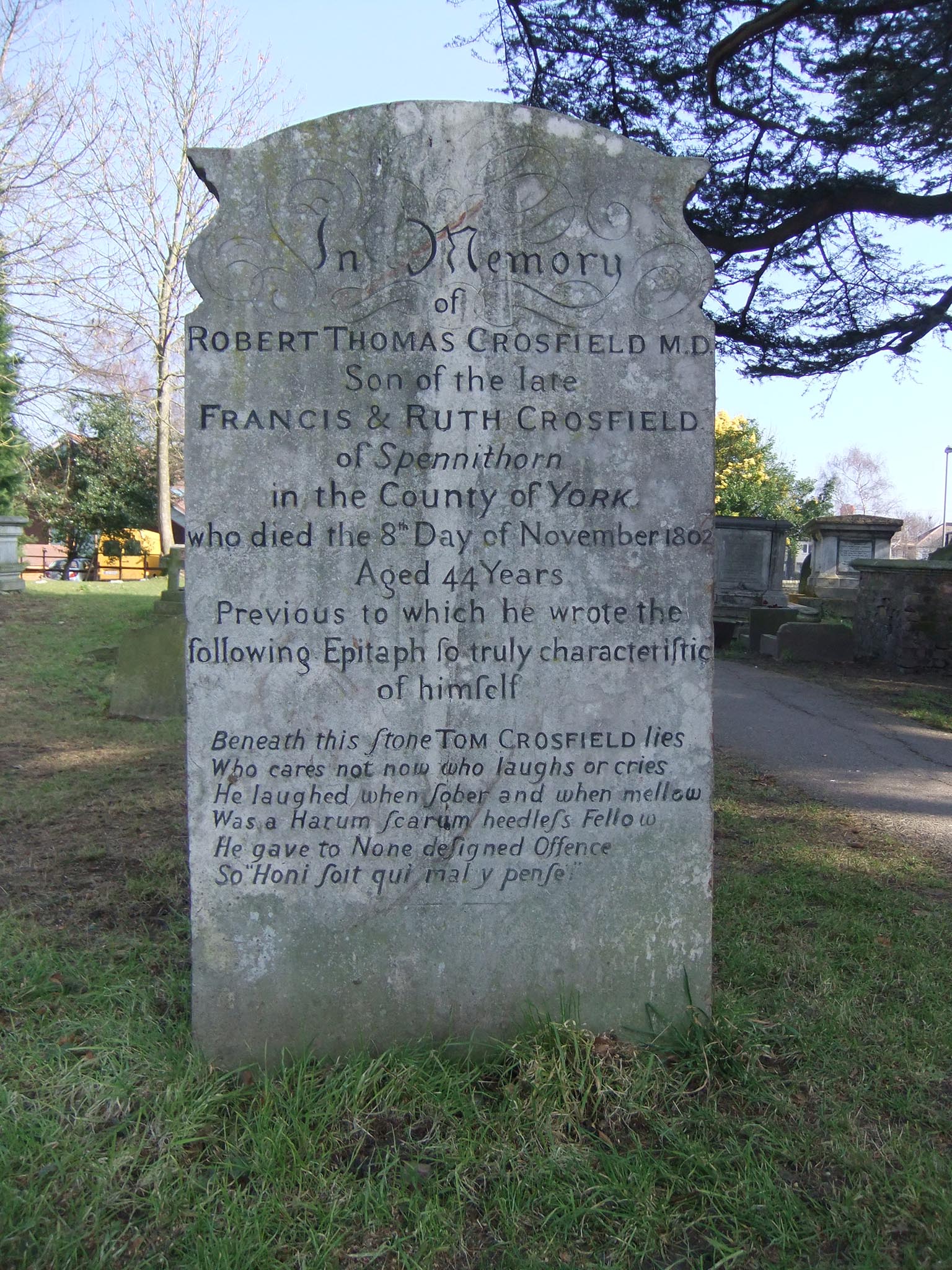
In the church of St. Mary , Hendon, London NW4.
Postscript
Given the strength of the evidence against their client, how did Gurney and Adam succeeded in extracting from the jury a verdict of not guilty? One factor may have been the less than universal popularity of the Hanoverians . The Crown may have faced an uphill struggle to justify the assertion that the loss of King George "might plunge the country into a state of anarchy and confusion ...". Rightly or wrongly, 'Farmer George' took the blame for the nation's ills; not least the loss of the American colonies. His son, the Prince Regent, was already going cap in hand to Parliament to obtain relief from his staggeringly high debt.
Did the jury hum along to "Plant, plant, the tree ..."? No, but some of it would probably have been inclined to. Really, though, the Crown's case is scuppered by the non-appearance of Thomas Upton: its principal witness. This, according to the prosecution, is because Upton is dead. The defence disagrees, and suggests that he lives still. Most likely, Upton has gone to ground, avoiding hostile questioning. Justice Eyre is uninterested either way; of sole relevance is that Upton is no-show.
What, though, of the elusive Captain Charles Clarke? What did he know of his surgeon's regicidal tendencies? Family legend, alas, is silent on the entire procedings, beyond assertions that Charles was a shipmaster of London and that he commanded a vessel called the Pomona. By the early years of the 20th. century, at the latest, all memory of the drama at Newgate had faded. It seems, though, that even in 1821 Charles still inclined to the politically radical when, together with his brother Samuel, he took a rural ride with William Cobbett.
The cargoes Welham Clarke is known to have carried were solely non-human, though his vessel, The Spy, was licenced to carry slaves. On the other hand, speculates John Le Bretton, Charles "may be on the coast of Africa ...". Might this explain why, 13 years after the trial, Charles commanded a vessel called The Anne, equiped for the transport of convicts to New South Wales? William Cobbett is also noted for some sharp criticism[6] of William Wilberforce . The only surviving log written by Charles is that of the Pomona, saved in the National Archives.[7] What part might Charles have played in other voyages of transportation?
Of the others, little is known. John Le Breton seems to have left the Old Bailey thinking that no calamity greater than the Pomona can befall him, and promptly signs up with Welham Clarke on his calamitous voyage to Lima where, by way of a change, the crew is gaoled in South America. No cartel ship rescues them from there.
After William Clarke's calamitous voyage to the East Indies in 1804, the Clarkes scale back their nautical ambitions on fishing trips. Me? An expedition to Sainsburys for kippers entails more excitement than I care for.